Why your cedar hedge is turning brown, and whether it will come back
Short answer
Where and when the brown shows up tells you the cause. Inner foliage browning in September and October is normal fall needle drop. Brown tips on the south, west or road side in March and April point to winter burn or salt spray, and brown patches at the base to salty slush or dog urine. Dead foliage won't green up, but a branch with live buds can regrow. An Ontario cedar that's brown all over rarely recovers.
Key numbers
- Normal inner needle drop
- September and October
- Winter burn and salt show up
- March and April
- Salt spray can reach white cedar
- 100 m or more from the road
- Water for established evergreens
- About 2.5 cm (1 inch) of water a week
- Prune out dead tips
- Mid-spring, after new foliage appears
In this guide
A cedar hedge turning brown isn’t always a dying one. In Markham and the rest of southern Ontario, browning in September and October is usually normal needle drop. Browning that shows up in March and April is more often winter burn or road salt.
Where the brown sits on the hedge, and when it showed up, tells you which one you’re dealing with.
Whether it comes back depends on the buds, not the colour. Dry, dead foliage stays brown, but a branch with live buds can push out new green growth. A branch with dead buds is finished.
Is it normal for a cedar hedge to turn brown in the fall?
Yes, if the brown is on the inside and the outer foliage is still green. Iowa State University Extension says arborvitae sheds its oldest, innermost foliage every fall, and that the outer growth stays green on a healthy plant. Those inner sprays turn yellow or brown, then drop, and there’s nothing to treat.
Arborvitae is eastern white cedar, the species behind hedge cedars like ‘Smaragd’ (Emerald) and ‘Pyramidalis’.
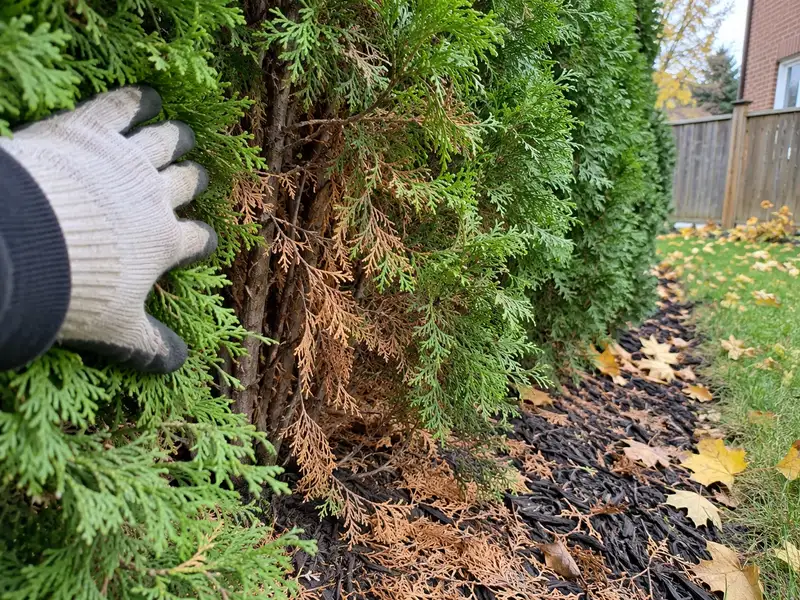
Push a hand into the hedge in October and you’ll get a fistful of brown scales while the outside looks fine. Iowa State notes that drought makes the drop heavier, so after a dry summer the inside of a hedge can look worse than usual.
Give it a good soaking before the ground freezes and leave it be.
Brown on the outer tips, or a whole plant going brown at once, is not normal.
Why is my cedar hedge turning brown?
It’s usually one of the causes in the table below, and the pattern on your hedge tells you which. The BC Ministry of Agriculture points out that a dying hedge usually has several stresses at once rather than one clear cause, so more than one row can apply.
Scroll sideways to see the whole table.
| Cause | When it shows | Where on the hedge | Will it green up again? |
|---|---|---|---|
| Seasonal needle drop | September to November | Inner, oldest foliage. Outer tips stay green | Yes. It’s normal (Iowa State) |
| Winter burn | As the snow melts in spring | South, southwest and west sides, tips first. Green below the old snow line | Partly. New growth fills in over a couple of seasons if buds are alive (UW-Madison) |
| Road salt spray | Late winter to early spring (UW-Madison) | Side facing the road, needle tips first | Partly, if buds survived. Damage can repeat every winter |
| Salt in slush and meltwater | After a winter of salting | Evenly along the lower part of the hedge (BC Ministry of Agriculture) | Roots can be killed. Flush the soil and see what leafs out |
| Drought or summer heat | Mid-summer, dry spells, dry falls | Dull or bronzed foliage (BC Ministry of Agriculture), heavier inner drop in fall (Iowa State) | Water it and wait. Check the buds before cutting anything |
| Root problems | Any time, often after a very wet season | Whole plants browning or dying, sometimes at random through the hedge | Often not. Waterlogged soil kills roots, and Armillaria root rot has no cure (BC Ministry of Agriculture) |
| Dog urine | Any time | Small yellow, brown or black patches at the base | No. That foliage dies |
Insects are another cause. Toronto Master Gardeners names cedar leaf miners and spider mites, and the BC fact sheet describes mites as overall yellowing or browning with speckled foliage, worst in hot, dry weather.
The same sheet says insects, disease and animal injury are less frequent causes than growing conditions, soil and planting problems.
Why do cedars brown on the side facing the road?
Salt spray is the usual suspect. In a 1979 study of roadside plants in Ontario, Hofstra, Hall and Lumis found that most of the injury came from wind-borne spray rather than salt in the soil, and that white cedar could be badly injured 100 m or more from the road.
Injury was heavier on the south and east sides of roads. The authors note that winter winds in most of southern Ontario blow from the northwest.
University of Wisconsin-Madison Extension says salt spray injury on evergreens shows up in late winter to early spring, mostly on the side facing the road. Needle tips turn brown or yellow, then the colour moves down the needle.
Driveways matter as well. The BC Ministry of Agriculture fact sheet says salty slush splashing onto a hedge damages the foliage, and salty meltwater collecting under it can kill roots.
What does winter burn look like on cedars?
Brown, dried-out foliage on the sunny side, showing up as the snow melts. UW-Madison Extension says foliage facing south, southwest or west is most often hit, while foliage buried under snow or facing away from the sun usually comes through fine.
So a cedar that’s brown on top and green at the bottom, with a clean line where the snow sat, is a classic case.
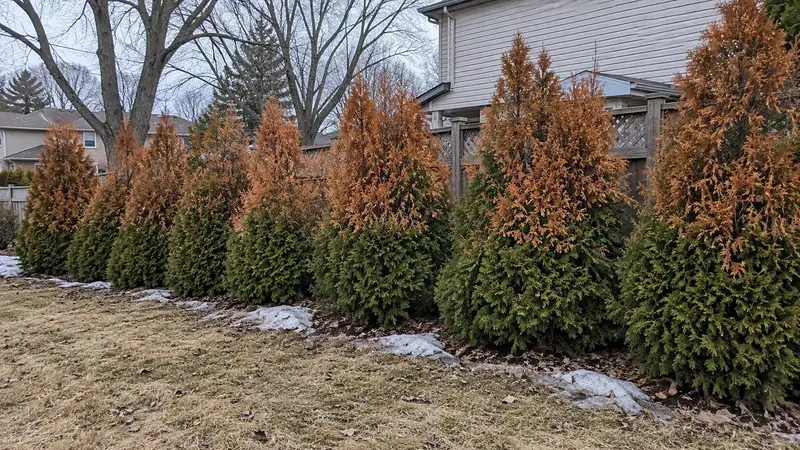
It happens when sun and wind dry the foliage on sunny winter days while the roots sit in frozen ground and can’t replace the water. UW-Madison lists road salt as a risk factor, along with a dry fall for young or newly planted evergreens.
Good to know
Bronze isn’t the same as brown. The BC fact sheet says cedar foliage can turn bronze, reddish brown or purplish in a cold winter or early spring, and that healthy plants green up as the growing season goes on. If it’s bronze rather than dry brown, wait until late spring before deciding.
Will a brown cedar hedge come back?
Partly brown cedars often do. Fully brown ones rarely do. UW-Madison Extension says damaged areas usually fill in with new foliage after a couple of growing seasons, but if an entire evergreen is brown, recovery is unlikely and replacing it is usually the better choice.
To check and trim a branch:
- Scratch the bark on a brown twig with your thumbnail. UW-Madison Extension says green tissue underneath means the branch may still leaf out. Brown, dry tissue means that part is dead.
- Wait until mid-spring. UW-Madison advises pruning out dead tissue after new foliage appears, so live buds get their chance.
- Cut back to a live side shoot or bud.
Watch out
Don’t cut into bare brown wood. Penn State Extension says that on needled evergreens other than yew, a branch cut back to bare wood won’t grow again, so trim dead tips back to live growth only.
How do you keep a cedar hedge from browning next winter?
Water it well into the fall and keep salt off it.
- Water deeply through dry spells right up until the ground freezes. UW-Madison Extension suggests about 2.5 cm (1 inch) of water a week for established evergreens. The BC fact sheet adds that cedars are shallow-rooted and that one or two deep waterings a week beat light, frequent ones.
- Keep a layer of mulch over the roots, held back from the trunks. The BC fact sheet says mulch helps keep soil moisture even, and our mulch guide covers how deep to go and how much to buy.
- Put up a loose burlap or snow fence screen on stakes on the road side or sunny side, with the top left open. UW-Madison advises against wrapping evergreens tightly in burlap.
- Don’t shovel or blow salty snow onto the hedge, and use less salt on the stretch of driveway beside it.
- In early spring, give the soil along a salted edge a heavy soaking. UW-Madison Extension recommends this to flush salt out of the root zone.
- Skip the fall shaping trim. Iowa State University Extension advises against pruning evergreens in fall because it leaves them more open to winter injury. Our guide on when to trim hedges in Ontario has the full timing.
Most of this fits into a normal fall cleanup in October and November.
Common mistakes with a browning cedar hedge
These make things worse or waste money:
- Cutting the brown sections back hard to “clean it up”. If the cut goes past the green, the gap usually stays.
- Pulling out plants in April before the buds have broken.
- Fertilizing a stressed hedge to perk it up. The BC fact sheet says too much fertilizer can damage roots and brown the foliage tips.
- Watering a little every day. Shallow watering keeps the surface damp and the roots dry, and a hedge sitting downhill from a watered lawn can end up with soggy roots.
- Wrapping cedars tightly in burlap, which UW-Madison says can collect ice and trap moisture.
- Hitting the trunks with the mower or string trimmer. The BC Ministry of Agriculture lists that kind of injury to the base among the causes of dying cedars.
When should you call someone?
Call when the dead wood needs to come out or the hedge is too tall to work on safely from the ground.
Clipping winter-killed tips back to live growth and cleaning the dead material out of the inside of a hedge is part of our hedge and bush trimming work across Markham, Richmond Hill and nearby.
Where a section is dead right through, replanting can make more sense than trimming, and planting is part of our work too.
If whole plants are dying at random, or you see white fungal growth under the bark at the base, that points to a root problem. Have a certified arborist look at it. We’re landscapers, not tree doctors.
For trimming or cleanup, call (437) 684-2535 or text us a photo of the hedge. The hedge trimming service page explains how the job works.
Other questions people ask
Can you save a cedar that is turning brown?
Often, yes, if the brown is limited to some branches and the buds on them are still alive. Scratch the bark on a brown twig: green tissue underneath means it may still put out new foliage. University of Wisconsin-Madison Extension says partly burned evergreens usually fill in over a couple of growing seasons, but a plant that has gone brown all over is unlikely to recover.
Why is my cedar hedge brown on the inside?
Usually because it's fall. Iowa State University Extension says arborvitae, which is what Ontario hedge cedars are, sheds its oldest innermost foliage every autumn, and that the outer growth stays green on a healthy plant. Drought can make the drop heavier than usual. If the outside of the hedge is still green, there's nothing to treat.
Why is my cedar hedge turning brown at the bottom?
Look at what reaches the base. The BC Ministry of Agriculture describes dog urine damage as small yellow, brown or black patches of dead foliage at the base of the trees, and salt damage as browning spread evenly along the lower part of a hedge, from salty slush and meltwater. The same fact sheet lists injury to the base of the trees from mowers and trimmers as another cause.
Should I cut the brown parts off my cedar hedge right away?
No, wait until mid-spring. UW-Madison Extension advises pruning out dead tissue after the new foliage has come out, so any live buds get their chance first. Scratch a brown twig with your thumbnail: green underneath means it may still leaf out. When you do cut, go back to a live side shoot, because Penn State Extension says cedar branches cut back to bare brown wood won't grow again.
Should I wrap my cedars for winter?
Wrap the ones that browned last winter, face a road or sit on an open, sunny side. University of Wisconsin-Madison Extension advises against wrapping evergreens tightly in burlap. Put up a loose screen of burlap or snow fence on stakes on the sun or road side instead, with the top left open. It also says anti-transpirant (anti-desiccant) sprays have been shown to have limited benefit.
Sources
- Iowa State University Extension: Why is the inner growth of my arborvitae turning brown?
- Iowa State University Extension: The proper time to prune trees and shrubs
- University of Wisconsin-Madison Extension: Winter burn
- University of Wisconsin-Madison Extension: Winter salt injury and salt tolerant landscape plants
- BC Ministry of Agriculture, Plant Health Unit: Dying cedar hedges, what is the cause? (2015)
- Hofstra, Hall and Lumis: Studies of salt-induced damage to roadside plants in Ontario (Arboriculture & Urban Forestry, 1979)
- Penn State Extension: Pruning needled evergreens
- Toronto Master Gardeners: Emerald cedars
Related guides and service
- When to trim hedges and shrubs in Ontario In Ontario, trim cedar, juniper and yew hedges in early spring before new growth starts, or around mid-June once the first flush of growth is done, with a light touch-up in midsummer.
- When to prune hydrangeas and other shrubs in Ontario: lilacs, spirea, forsythia and more When to prune hydrangeas and other shrubs in Ontario depends on when they flower.
- Fall cleanup checklist: what to do before winter A fall cleanup in Ontario means getting the leaves off the lawn and hard surfaces, clearing out the beds, cutting back only diseased or collapsed plants, mowing one last time to about 5 cm (2 inches), and shutting off…
- How much mulch do you need? A calculator, the right depth and when to mulch For most Ontario garden beds, spread mulch 2–3 inches (5–7.5 cm) deep, and no more than 4 inches.