How much mulch do you need? A calculator, the right depth and when to mulch
Short answer
For most Ontario garden beds, spread mulch 2–3 inches (5–7.5 cm) deep, and no more than 4 inches. One cubic yard covers about 108 sq ft at 3 inches, or 162 sq ft at 2 inches. In the GTA, put it down in spring once the soil has warmed and drained, or in fall once the soil has cooled, and keep it pulled back from stems and trunks.
Key numbers
- Depth for most beds
- 2–3 in (5–7.5 cm)
- Maximum depth
- 4 in (10 cm)
- 1 cubic yard at 3 in covers
- About 108 sq ft (10 m²)
- 1 cubic yard at 2 in covers
- About 162 sq ft (15 m²)
- 2 cu ft bags in 1 cubic yard
- About 13.5
Mulch calculator
Enter the bed area and the depth you want. Measure each bed in feet (or metres), multiply length by width and add them up.
About 0.93 cubic yards
For 100 sq ft at 3 in deep · 0.71 m³ in bulk, or 13 bags of 2 cu ft.
Round up when you order. Bag sizes vary, so check the volume printed on the bag.
Rather not do it yourself? Get a free quote.
In this guide
To work out how much mulch you need, multiply the bed’s area in square feet by the depth in inches and divide by 324. That gives cubic yards. For most Ontario beds, aim for 2–3 inches deep, and expect one yard to cover about 108 sq ft at 3 inches.
Most people buy mulch by eye instead: a few bags, then a few more, then one last trip to the store. The math takes two minutes with a tape measure. The harder part is the depth and the timing. Too thin and weeds come straight through. Too thick, or piled against stems, and it does more harm than good.
Mulch installation is one of the jobs we do around Markham as part of our garden bed, planting and mulching work. It’s also an easy one to do yourself once you have the numbers below.
How deep should mulch be?
Two to three inches (5–7.5 cm) suits most garden beds, and four inches (10 cm) is the upper limit. University of Tennessee Extension says a 2–4 inch layer cuts down weed growth and holds moisture in the soil, and that the layer should be no more than four inches deep.
The University of Wisconsin–Madison Extension says to apply most organic mulches about 3 inches deep.
What you’re mulching changes the number a little:
Scroll sideways to see the whole table.
| What you’re mulching | Depth | Source |
|---|---|---|
| Perennial beds | A couple of inches | The Morton Arboretum |
| Under trees and shrubs | 3–4 in of medium to coarse material | The Morton Arboretum |
| Heavy soil that drains slowly | Thinner, about 2–3 in | Penn State Extension, Iowa State Extension |
Penn State Extension says to use less on poorly drained soil, and Iowa State Extension suggests 2–3 inches on heavy soils. If the bed already has mulch, you’re only topping it back up to 2–3 inches, often an inch or less.
Watch out
Whatever the depth, keep mulch off the stems and trunks. The Morton Arboretum’s advice is to pull it away from the base and leave a “donut hole” around each trunk.
Oregon State University Extension notes that mulch piled against a trunk can attract slugs, sow bugs and mice that chew the bark.
How much mulch do I need?
Multiply the bed’s area in square feet by the depth in inches, then divide by 324. The answer is cubic yards.
That’s the formula Texas AgriLife Extension gives. It works because a cubic yard is 27 cubic feet, and 27 × 12 = 324.
To get the area, measure the length and width of each bed in feet and multiply. For curved or odd-shaped beds, split them into rough rectangles and add them up. A few square feet either way won’t matter.
For example, an L-shaped bed made of a 20 by 4 ft strip and an 8 by 4 ft return is 80 + 32 = 112 sq ft. At 3 inches deep, that’s 112 × 3 ÷ 324, or about 1.04 cubic yards.
Here’s how far one cubic yard goes at common depths:
Scroll sideways to see the whole table.
| Depth | One cubic yard covers | 2 cu ft bags per 100 sq ft |
|---|---|---|
| 1 inch (2.5 cm) | about 324 sq ft (30 m²) | about 4 |
| 2 inches (5 cm) | about 162 sq ft (15 m²) | about 8 |
| 3 inches (7.5 cm) | about 108 sq ft (10 m²) | about 12.5 |
| 4 inches (10 cm) | about 81 sq ft (7.5 m²) | about 17 |
The 108 sq ft figure at 3 inches matches what University of Tennessee Extension publishes. One yard holds about 13.5 bags of 2 cu ft, so for bagged mulch, check the size printed on the bag and divide.
Three worked examples
- A front bed along the house, 20 ft by 4 ft, mulched 3 inches deep: 80 × 3 ÷ 324 = 0.74 cubic yards. That’s 20 cu ft, or 10 bags of 2 cu ft.
- Beds around a backyard totalling 300 sq ft, new and bare, 3 inches deep: 300 × 3 ÷ 324 = 2.8 cubic yards. Order 3 yards in bulk rather than 38 bags.
- The same 300 sq ft the next spring, topped up by 1 inch: 300 × 1 ÷ 324 = 0.93 cubic yards, roughly 13 bags.
Good to know
Round up rather than down. Mulch settles a little once it’s down, and running short halfway down a bed means another trip.
When is the best time to mulch in Ontario?
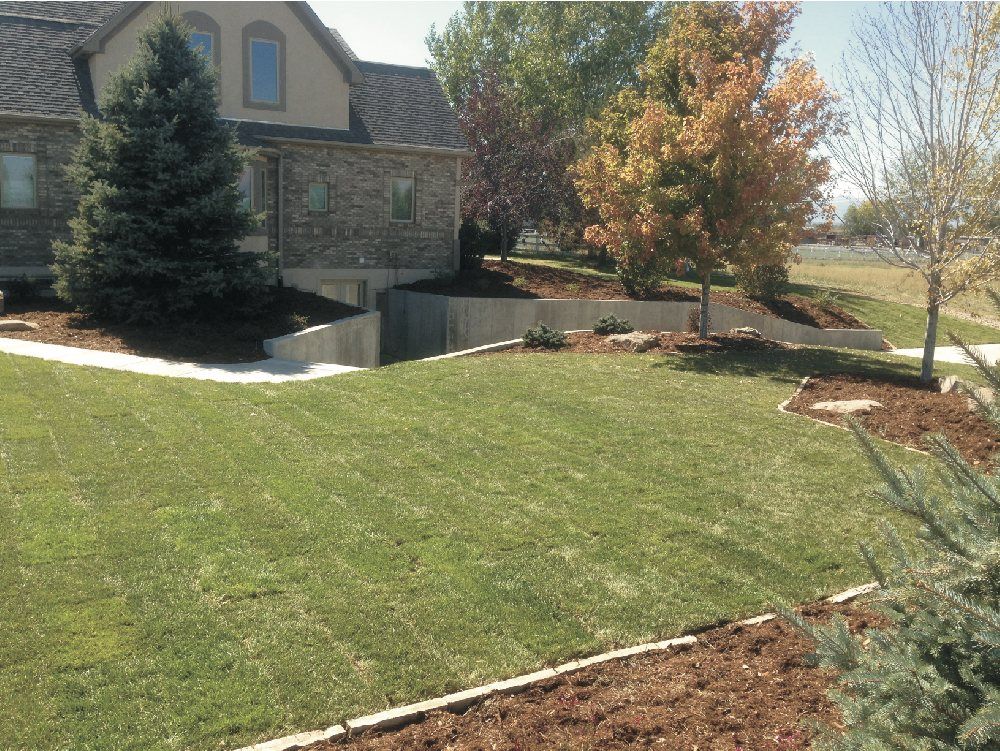
Mulch in spring once the soil has warmed and the extra water has drained away, or in fall once the soil has started to cool. The Morton Arboretum gives that timing for trees and shrubs. In fall, it says to wait until frosts are coming regularly, since a single frost doesn’t mean the soil has cooled.
The Wisconsin extension warns that organic mulch put down too early in spring keeps the soil cold longer and slows plant growth.
Around Markham and the rest of the GTA, that means not rushing out the week the snow goes. Beds are often still cold and soggy then. In spring, wait until:
- the soil is workable and crumbles in your hand instead of smearing
- the perennials have started to come up, so you can see where they are and don’t bury them
If you want free mulch and can haul it yourself, the City of Markham runs a self-serve mulch giveaway around Earth Month. In 2026 it was on May 2 and 3 at Milliken Mills Park, and residents brought their own bags.
Check the city’s website in spring for the next dates. Our Markham area page has the city’s yard waste pickup dates too.
Fall works well too, and it’s a good time to top up after a fall cleanup. For a winter layer over perennials, the Wisconsin extension suggests waiting until after several freezes.
Common mulching mistakes
- Mulch piled against tree trunks and shrub stems, keeping the bark wet all season.
- A fresh 3 inches spread over old mulch every spring, until the bed is 6 or 8 inches deep and the plants struggle.
- Mulch spread over weeds that weren’t pulled first. Cornell’s weed management guide says to clear weeds before mulching, because weeds can still push up through the layer.
- Mulch heaped against the house so it touches wood siding or door and window frames. The University of Kentucky’s termite guide notes that mulch holds moisture and says it should never touch them.
- Fine, shredded mulch spread thick and left to pack down. The Morton Arboretum notes that fine-textured mulches tend to pack down and hold moisture, and Penn State Extension suggests breaking up matted layers by hand or with a rake.
- Wood chips dug into the soil when planting. Oregon State University Extension says mixing chips into soil makes them more likely to tie up nitrogen. Left on top as mulch, they break down slowly and get worked in by worms over time.
Is mulch installation worth paying for?
For a few small beds, usually not. It’s an easy Saturday morning job, and buying bags means no pile on the driveway.
Where it gets heavy is volume. Three yards of bulk mulch is a lot of wheelbarrow trips, and it goes much faster if the beds are weeded and edged first.
It’s usually worth getting help when:
- the beds are overgrown and need weeding and a new edge before any mulch goes down
- there’s old mulch to pull back from trees and the house
- you’re redoing several beds at once
Our guide on low-maintenance garden beds covers how to set beds up so they need less work each year. The spring cleanup checklist shows where mulching fits in the season.
If you’d like us to take a look, call or text (437) 684-2535, or ask for a free quote on our garden beds, planting and mulching page.
Other questions people ask
Can I just put new mulch over old mulch?
Usually, yes. Check how much is left first. If there's still 2 inches or so of old mulch, rake it to loosen any matted crust and add only an inch to bring the total back to 2–3 inches. The Morton Arboretum suggests checking the depth every year and topping up as needed. Penn State Extension points out that piling new mulch on old year after year is the same as putting down too deep a layer all at once.
Can you use too much mulch?
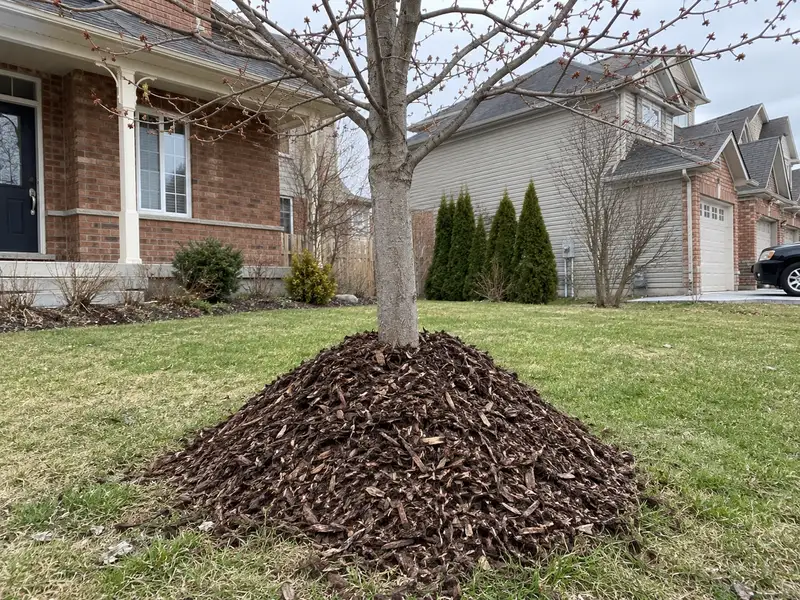
Yes. University of Tennessee Extension says the layer should be no more than 4 inches deep and shouldn't touch the trunks and stems of trees and shrubs. Penn State Extension warns that very deep mulch can leave the soil underneath waterlogged and short of oxygen, which harms roots. Cones of mulch piled up against tree trunks, often called volcano mulching, keep the bark damp and can harm the roots and the trunk.
How much will 20 bags of mulch cover?
It depends on the bag size printed on the bag. Twenty 2 cu ft bags hold 40 cu ft. Spread 3 inches deep, that covers about 160 sq ft. At 2 inches it covers about 240 sq ft. For any bag, multiply the cubic feet by 12 and divide by the depth in inches to get the square feet it covers.
Is it cheaper to buy bags of mulch or bulk?
Compare the price per cubic foot. Divide the bulk price for one cubic yard (plus delivery) by 27, and divide the bag price by the cubic feet on the bag. For one small bed, bags are often simpler since there's no delivery charge and no pile on the driveway. Once you need more than a yard or so, which is about 13.5 bags of 2 cu ft, bulk delivery is worth pricing out.
Should I remove old mulch every year?
Not as a rule. Organic mulch breaks down into the soil, and that's part of what it's for. Take some out only if the layer is already deeper than 3–4 inches, if it's piled against stems or the house siding, or if it has packed into a dense, matted layer. Penn State Extension notes that some old mulch may need to come out before a new layer goes on. Otherwise break up any matted patches with a rake and top it up.
Sources
- University of Tennessee Extension: Using Mulch in the Landscape
- Texas AgriLife Extension (Travis County): How much compost, soil or mulch do I need to purchase? (PDF, hosted by UC ANR)
- Penn State Extension: Mulching landscape trees
- Iowa State University Extension: How deep should the mulch layer be around trees and shrubs?
- Cornell University: Mulch (weed management for landscape beds)
- University of Kentucky Entomology: Protecting your home against termites
- The Morton Arboretum: Mulching trees and shrubs
- University of Wisconsin–Madison Extension: Mulches for home gardens and plantings
- Oregon State University Extension: Wood chips for mulch?
- City of Markham: Earth Month 2026 (mulch giveaway)
Related guides and service
- Lowest-maintenance landscaping: garden beds for GTA yards The lowest-maintenance landscaping for most yards in Markham and the GTA is a planted bed that covers its own soil.
- Garden bed edging: interlock, steel, plastic or a spade-cut edge, and which lasts in Ontario For garden bed edging in Ontario, steel lasts longest and an interlock border on a gravel base holds up well.
- Spring cleanup checklist for Ontario yards Do a spring yard cleanup in Ontario in two rounds. Once the snow is gone and the ground is firm, usually in April in the GTA, pick up branches, sweep hard surfaces, rake the lawn lightly and prune shrubs.
- Fall cleanup checklist: what to do before winter A fall cleanup in Ontario means getting the leaves off the lawn and hard surfaces, clearing out the beds, cutting back only diseased or collapsed plants, mowing one last time to about 5 cm (2 inches), and shutting off…