Lowest-maintenance landscaping: garden beds for GTA yards
Short answer
The lowest-maintenance landscaping for most yards in Markham and the GTA is a planted bed that covers its own soil. Pick plants that suit the light and are hardy to zone 6b, and space them to fill in. Cut a clean edge so lawn can't creep in. Keep 5–10 cm of wood mulch down and top it up every two to three years. Skip landscape fabric and invasive groundcovers like goutweed.
Key numbers
- Markham hardiness zone
- 6b (1991–2020 map)
- Full sun
- At least 6 hours of direct sun
- Part shade
- 4 to 6 hours of sun
- Full shade
- Less than 4 hours of sun
- Wood mulch depth
- 5–10 cm (2–4 in)
In this guide
The lowest-maintenance landscaping for most GTA yards is a garden bed planted closely enough to cover its own soil, with a clean edge and a layer of mulch. Beds that turn into a weekly chore usually weren’t planted badly. They have too much bare soil, no real edge and a few plants that hate the spot they’re in.
Weeds need light and open ground, grass spreads in from the lawn, and a struggling shrub needs watering every summer. Fix those and the bed asks very little of you.
The steps below are the same whether you do the work yourself or have it done as a garden bed and planting job.
Why is a planted bed the lowest-maintenance landscaping?
Once the plants fill in, they shade out most weeds and there’s nothing to mow. What work is left in a garden bed comes from four places:
- Weeds growing in bare soil between plants.
- Lawn grass creeping in along the edge.
- Plants that need extra water, spraying or replacing because they’re in the wrong light or the wrong zone.
- Plants that outgrow the space and need cutting back several times a year.
Everything below is about cutting down one of those four.
Which plants need the least care in Ontario?
The plants that need the least care are the ones that suit your light, your soil and the winter. Start with the winter.
Natural Resources Canada puts Markham in plant hardiness zone 6b on its current map (1991–2020 climate data), up from 6a on the older 1961–1990 map.
A plant rated for zone 6 or lower should get through a normal winter here. One rated zone 7 is a gamble.
Match the plant to the light
Watch the bed for a full day in summer and count the hours of direct sun. Toronto Master Gardeners sort beds like this:
Scroll sideways to see the whole table.
| Light | Sun the bed gets |
|---|---|
| Full sun | At least 6 hours of direct sun, late morning and afternoon |
| Part shade | 4 to 6 hours of sun, with shade at midday |
| Full shade | Less than 4 hours of sun |
Around a house, beds on the south side usually get the most sun. Beds on the east or west side often get only morning or afternoon sun, which tends to put them in part shade.
The north side of a house or fence usually lands in that last group. A sun lover in shade tends to get leggy and weak, and a shade plant in hot sun can scorch. Either way you end up replacing it.
Start with native plants
Landscape Ontario’s guide to native plants says they’re better adapted to local climate and soil and more resistant to local pests and disease. That means less time and money to keep them going.
Some reliable picks from Ontario sources:
Scroll sideways to see the whole table.
| Spot | Plants to look at | Source |
|---|---|---|
| Full sun, dry soil | Thyme, hens and chicks, creeping potentilla, bearberry (needs acidic soil), low junipers | City of Guelph |
| Sun, groundcover | Wild strawberry, barren strawberry, prairie smoke | Credit Valley Conservation |
| Shade | Wild ginger, heart-leaved foamflower, heart-leaved aster | Credit Valley Conservation |
| Part shade, groundcover | Sedge, bishop’s hat (barrenwort), lungwort, wintergreen | City of Guelph |
| Shrubs and small trees | Red osier dogwood, winterberry holly, serviceberry, nannyberry | Landscape Ontario |
| Avoid in beds | Goutweed, periwinkle, lily-of-the-valley | Credit Valley Conservation, Ontario Invasive Plant Council |
Skip the groundcovers that never stop
That last row matters more than it looks. Credit Valley Conservation says goutweed spreads aggressively through underground stems (rhizomes) and by seed, and can take over a garden and sneak onto a neighbour’s property.
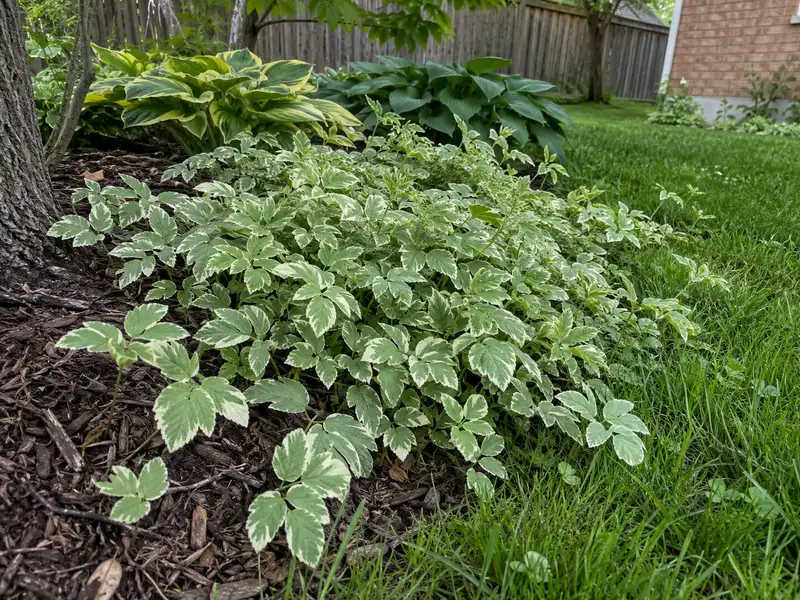
Periwinkle and lily-of-the-valley are sold as easy groundcovers for the same reason they cause trouble: they don’t stop spreading.
The Ontario Invasive Plant Council’s Grow Me Instead guide for southern Ontario lists both as invasive, along with goutweed and English ivy, and suggests plants to grow instead. Lily-of-the-valley, for one, spreads by rhizomes into dense colonies.
Watch out
Look up any groundcover sold as fast-spreading in the Grow Me Instead guide before it goes in the ground. Once goutweed’s rhizomes are in a bed, they’re hard to get out.
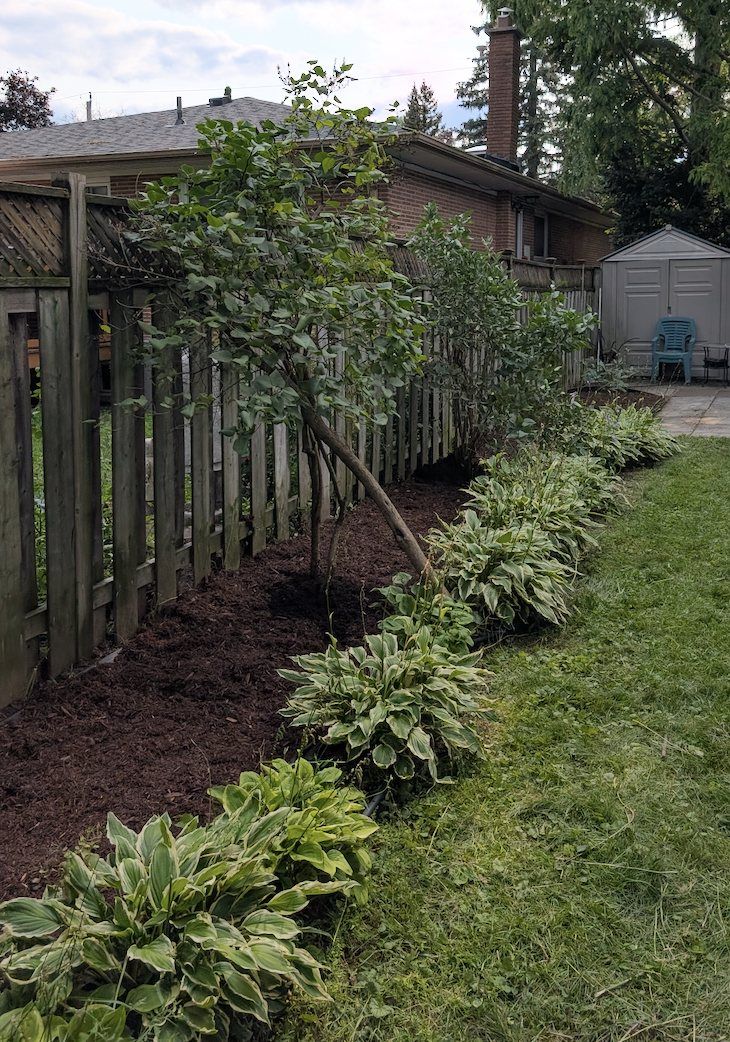
How close together should you plant?
Close enough that the plants will cover the soil within a few seasons. The spacing or width on a plant tag is roughly its mature spread, so plants set that far apart will only touch once they’re full grown.
Planting a little tighter than that fills the gaps sooner, as long as you’re not crowding shrubs that will need cutting back every year to fit.
Plant in groups of three, five or seven of the same thing instead of one of everything. Landscape Ontario’s native planting advice makes the same point: clumps look more natural than single plants scattered all over.
Fewer kinds of plants also means fewer different care routines to remember.
Think about the size the plant will be in five years, not the size of the pot. A cedar or a lilac planted a metre from the house will need shearing every year to stay off the siding.
Pick a shrub whose natural size fits the space and it rarely needs more than a light trim. Our guide on when to trim hedges and shrubs in Ontario covers timing for the ones that do.
How much mulch keeps the weeds down?
A layer 5–10 cm (2–4 in) deep of wood or bark mulch. Cornell University’s weed science guidance says that depth alone can give adequate weed control, because a thinner layer lets light reach the weed seeds.
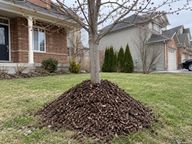
Piling on far more wastes mulch, and Cornell warns that excess mulch can kill shrubs and trees. Keep it off stems and trunks, where the Morton Arboretum notes it traps moisture and invites decay.
Our mulch guide covers how much to buy, when to put it down and how wide a gap to leave around trunks.
Mulch won’t fix every weed problem. Cornell says it mainly suppresses annual weeds, the ones that sprout from seed each year, by blocking the light they need.
Good to know
Perennial weeds like dandelions and bindweed come back from their roots, and mulch won’t stop them. Dig them out, roots and all, before the mulch goes down.
Is landscape fabric worth it?
For planted beds, usually not. Cornell’s guidance on weed barriers lists the problems:
- It works for a relatively short time.
- It does little against perennial weeds.
- New weeds root into it, which makes them harder to pull.
It also snags on tools, and taking out old fabric around established plants is slow, messy work.
Washington State University extension horticulturist Linda Chalker-Scott points out that any organic mulch or soil on top of the fabric speeds up weeds colonizing it, and that weeds eventually grow on top of and through it. Mulch rots down into a thin layer of soil, and seeds that blow in grow right there.
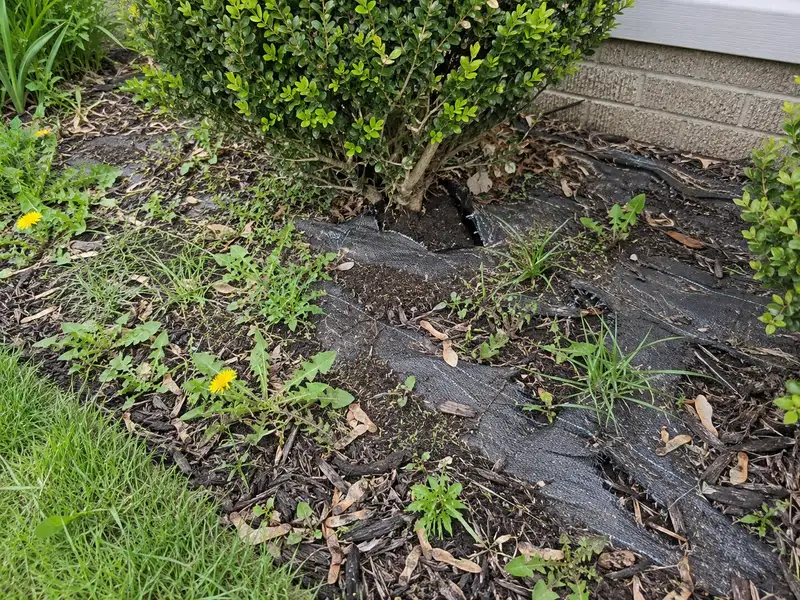
You also can’t add or move plants without cutting holes in it. Mulch over well-weeded bare soil does the same job without the cleanup later.
Why does edging matter so much?
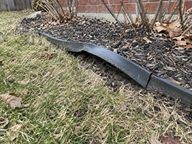
Lawn grass spreads sideways, and without a clear line it creeps a little further into the bed every season. A crisp edge also makes a bed look cared for even when it hasn’t been weeded in a while.
Scroll sideways to see the whole table.
| Edge | Up front | Upkeep |
|---|---|---|
| Cut edge (a spade-depth trench between lawn and bed) | Cheapest | Needs recutting now and then through the season |
| Stone, interlock or steel border | Costs more | Saves the recutting |
Our garden bed edging guide compares the options and which ones survive an Ontario winter.
On our sod, edging and mulch project an interlock border edge separates the new sod from the mulched beds.
Common mistakes
- Planting into soil that still has grass roots and perennial weeds in it. They come straight back up through the mulch.
- Buying plants on looks at the garden centre without checking the light and zone on the tag.
- Leaving wide gaps between small plants and filling them with mulch forever, instead of planting enough to cover the ground.
- Piling mulch against stems and trunks (“mulch volcanoes”).
- Laying landscape fabric and then wondering why the weeds are growing on top of it.
- Choosing a fast groundcover that turns out to be invasive.
- Skipping water in the first summer. Many groundcovers are only drought tolerant once established (the City of Guelph’s list says this about several), so water new plantings deeply until their roots take hold.
When should you plant a new bed in Ontario?
Plant in spring, once the soil has thawed and dried enough to work without turning to mud, or in early fall.
Fall planting has the advantage of cooler weather, but plants need time to root before the ground freezes, so earlier in the fall is safer than later.
Mulching and edging can be done any time the ground isn’t frozen. They fit naturally into a spring cleanup or a fall cleanup.
Doing it yourself or getting help
Tidying, edging and mulching an existing bed is a good weekend job.
The heavy part is starting a new bed or rescuing one that has gone wild: lifting sod, digging out weed roots and old shrubs, moving soil and mulch by the barrow, and hauling the debris away. That’s the part most worth handing over.
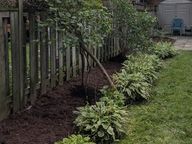
Our weed treatment and clean-up project shows a bed along a fence that was overgrown with weeds and long grass, cleared back to the hostas and covered in fresh mulch.
If you’d like us to look at yours, call or text (437) 684-2535, or read more about our garden bed, planting and mulching service. We work across Markham and nearby, including Richmond Hill and Stouffville, and quotes are free.
Other questions people ask
What is the lowest maintenance landscaping?
For most GTA yards it's a bed of shrubs and perennials that suit the spot, planted close enough to shade out the soil, with a cut edge and a layer of wood mulch. Once it fills in there's little to do beyond pulling the odd weed, a spring trim and topping up the mulch every couple of years. Lawn needs mowing every week or so through the growing season, so swapping a patch of it for planting usually means less work overall.
What are some easy and low-maintenance garden plants?
Easy plants are the ones that suit your light and soil. For sunny, dry spots, the City of Guelph lists thyme, hens and chicks, creeping potentilla and bearberry as groundcovers. For shade, Credit Valley Conservation suggests wild ginger, heart-leaved foamflower and heart-leaved aster. Native shrubs such as red osier dogwood, serviceberry and winterberry holly are on Landscape Ontario's native plant list, which says natives are better adapted to the local climate. Check the hardiness zone on the tag too.
What's the cheapest way to build a garden bed?
Smother the grass instead of digging it out. Lay overlapping cardboard over the lawn where the bed will go, wet it, and cover it with a thick layer of mulch or compost. The grass needs time to die off and the cardboard time to soften, so it's easiest to lay it in fall and plant in spring. Buy smaller pots and plant them a little closer together, and divide perennials you already have.
Does landscape fabric stop weeds in garden beds?
Not for long. Cornell University's weed science guidance says fabric is effective for a relatively short period, does little against perennial weeds, and that new weeds root into the fabric, which makes them harder to pull. Washington State University extension adds that any mulch or soil on top of the fabric speeds up weeds colonizing it. A proper depth of wood mulch over bare soil works as well and is far easier to plant through later.
Sources
- Cornell University CALS, Turfgrass and Landscape Weed ID: Mulch
- Cornell University CALS, Turfgrass and Landscape Weed ID: Weed barriers
- Natural Resources Canada: Plant hardiness zone by municipality
- Credit Valley Conservation: Invasive goutweed
- Landscape Ontario: Landscaping with native plants
- City of Guelph: Groundcovers and lawn alternatives
- Ontario Invasive Plant Council: Grow Me Instead, Southern Ontario (3rd edition, 2020)
- Washington State University Extension (Linda Chalker-Scott): The myth of landscape fabric
- The Morton Arboretum: Mulching trees and shrubs
- Toronto Master Gardeners: Ornamental shrubs for various light conditions
Related guides and service
- How much mulch do you need? A calculator, the right depth and when to mulch For most Ontario garden beds, spread mulch 2–3 inches (5–7.5 cm) deep, and no more than 4 inches.
- Garden bed edging: interlock, steel, plastic or a spade-cut edge, and which lasts in Ontario For garden bed edging in Ontario, steel lasts longest and an interlock border on a gravel base holds up well.
- When to trim hedges and shrubs in Ontario In Ontario, trim cedar, juniper and yew hedges in early spring before new growth starts, or around mid-June once the first flush of growth is done, with a light touch-up in midsummer.
- Spring cleanup checklist for Ontario yards Do a spring yard cleanup in Ontario in two rounds. Once the snow is gone and the ground is firm, usually in April in the GTA, pick up branches, sweep hard surfaces, rake the lawn lightly and prune shrubs.