Deck staining in Ontario: when to stain, when not to, and which stain
Short answer
In Ontario, deck staining goes best from late May to mid-September, on wood that's dry right through, with no rain in the forecast. Labels set the limits: Benjamin Moore's Arborcoat semi-solid needs 4.4 to 32.2 °C and wood moisture under 15%, and PPG's oil stain needs more than 10 °C. Around Markham and the GTA, skip wet mornings, hot midday sun and late fall. Deck floors usually need a fresh coat every 1 to 2 years.
Key numbers
- Best months around the GTA
- Late May to mid-September
- Arborcoat semi-solid temperature
- 4.4 to 32.2 °C
- Arborcoat wood moisture
- Below 15%
- PPG oil stain temperature
- Above 10 °C
- Restain the floor boards
- Every 1 to 2 years
In this guide
In Ontario, stain a deck between late May and mid-September, on wood that’s dry right through, with a clear forecast and a temperature inside the range on the label. Plenty of jobs go wrong for reasons that have nothing to do with the brand: the stain went on the wrong day, onto wood that wasn’t ready, or over a finish it can’t soak into.
Get the weather and the wood right and an ordinary penetrating stain does fine. Get them wrong and even an expensive one can go blotchy or peel early.
If you’d rather hand it off, see our deck staining and waterproofing service.
When is the best time to stain a deck in Ontario?
Around the GTA, late May to mid-September is the reliable stretch. The first half of September is often the easiest: it rarely passes 30 °C, and the nights haven’t turned cold yet.
The limit is the stain label. PPG’s oil-based REZ deck stain asks for air, surface and product temperatures above 10 °C. Benjamin Moore’s waterborne Arborcoat semi-solid allows 4.4 to 32.2 °C and needs wood moisture below 15%.
Here are the months at the Buttonville station in Markham, from Environment Canada’s 1981–2010 climate normals:
Scroll sideways to see the whole table.
| Month | Average high / low | Days with rain | For staining |
|---|---|---|---|
| April | 12.1 / 1.2 °C | 11 | Usually too cold and damp |
| May | 19.1 / 6.8 °C | 12 | Good from late May |
| June | 24.6 / 12.6 °C | 12 | Good |
| July | 27.1 / 15.2 °C | 11 | Good, but stain early in the day |
| August | 26.0 / 14.3 °C | 10 | Good |
| September | 21.5 / 9.9 °C | 11 | Good, especially the first half |
| October | 14.1 / 3.6 °C | 13 | Only mild, dry days early in the month |
Days with rain means days with at least 0.2 mm. The numbers hide two catches.
In July, Buttonville averages about 7 days above 30 °C, and boards in full sun get much hotter than the air. In October the days can still pass 10 °C, but nights average 3.6 °C and about 7 of them drop to freezing or below. The stain dries slowly and dew sits on it overnight.
When should you not stain a deck?
Don’t stain wet wood, with rain due, or outside the label’s temperature range. The labels add a few more cases:
- Late in the day. PPG says to avoid staining when dew and condensation are likely to form.
- Hot boards in direct sun. PPG warns against it, and Benjamin Moore says direct sunlight stops its stain soaking in properly and causes lap marks.
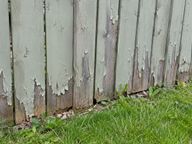
- Over loose or peeling finish. PPG calls removing loose or peeling coatings “extremely important”.
- On fresh pressure-treated wood that still beads water (see below).
Watch out
Washing day isn’t staining day. The USDA Forest Products Laboratory (FPL) says to allow at least 2 warm, windy days of drying after cleaning a deck with a bleach solution.
Drying times matter for the forecast too. Benjamin Moore lists half an hour to touch and 48 hours before normal foot traffic for Arborcoat. PPG lists 24 hours to touch for its oil stain.
Both are measured at 25 °C and 50% humidity, and Benjamin Moore notes that cool, humid weather stretches them.
How long should new pressure-treated wood dry before staining?
There’s no fixed number of weeks. New treated lumber is ready when it absorbs water.
Wood Preservation Canada says a water repellent or semi-transparent stain can go on once the wood is dry, and that new treated lumber may still be damp from treatment. Too much moisture keeps the finish from soaking in and can leave blotchy colour or poor adhesion. Their test is to sprinkle water on the boards: if it soaks in, go ahead.
You usually don’t need the 6 to 12 months of weathering people often quote. The University of Missouri Extension, citing the FPL, says wood treated with waterborne preservatives can be finished right after installation as long as it’s dry.
One exception: the FPL says decking with a factory-applied water repellent, or a deck recently finished with one, may need 2 to 3 months of weathering before a semi-transparent stain will absorb.
Waiting up to a year lets the wood take more finish, the FPL says, but it also invites checking. It notes that most decks get replaced because of cracks and checks that finishing on time would mostly have prevented.
Which deck stain should you use?
For deck floors, a penetrating finish beats a film. The FPL says penetrating finishes perform better and are easier to reapply on decks. Paint and solid-colour stain trap moisture, wear through where people walk, and fail by peeling.
Scroll sideways to see the whole table.
| Finish | How it works | Peeling risk | Notes from the sources |
|---|---|---|---|
| Clear water-repellent preservative | Soaks in, no pigment | Very low | FPL puts its service life at about 1 year on exposed deck surfaces, but it’s the easiest to reapply |
| Semi-transparent stain | Soaks in, some pigment, grain shows | Very low | FPL says oil-based semi-transparent stain doesn’t form a film, so it won’t blister or peel even if moisture gets into the wood |
| Semi-solid stain | Soaks in, more pigment, evens out colour | Low if applied thin | Benjamin Moore warns that heavy coats can end up looking like solid colour. The FPL notes waterborne finishes tend to form more of a film than oil-based ones |
| Solid stain or paint | Forms a film on top, hides the grain | High on floor boards | FPL says these can perform well on railings |
To the FPL, penetrating versus film-forming matters more than oil versus water. Oil-based stains like PPG’s REZ soak in and dry slowly. Waterborne ones like Arborcoat dry fast and clean up with water.
Watch out
Match the new stain to what’s already on the deck. Benjamin Moore says Arborcoat can go over a weathered transparent stain that isn’t flaking, but anything peeling has to come off first.
Going by the FPL’s advice, a practical setup for many GTA decks is a semi-transparent stain on the floor and stairs, with the same product or a solid colour on the railings.
If you’re choosing between a clear sealer and a stain, our guide to deck sealer vs stain vs waterproofing compares how long each lasts.
Can you put deck stain over paint?
Not a penetrating stain. It needs bare, absorbent wood, and paint blocks it.
The U.S. General Services Administration’s procedure for staining wood says not to apply semi-transparent stain over paint, solid stain or varnish. Wood finished with full-body paint should be repainted instead.
That leaves two options for a painted deck:
- Scrape and sand off everything loose, then repaint, knowing you’ll be doing it again.
- Strip or sand back to bare wood and switch to a penetrating stain. This costs more up front and gets you out of the peeling cycle.
If you’re weighing the same question for a fence, our fence painting vs staining guide covers it.
How much stain does a deck need?
Coverage depends on the product and how thirsty the wood is. From the data sheets:
Scroll sideways to see the whole table.
| Stain | Coverage per coat | Coats |
|---|---|---|
| Benjamin Moore Arborcoat semi-solid | 300 to 400 sq ft per 3.79 L can | Second coat recommended |
| PPG REZ semi-transparent oil | 150 to 250 sq ft per gallon | One thin coat |
Stairs, railings and spindles add a lot of surface, so buy extra. Running out halfway across the boards leaves lap marks.
Our deck staining cost guide works out the cans for common deck sizes.
How often does a deck need restaining?
For the floor boards, plan on every 1 to 2 years. That’s the University of Missouri Extension’s figure for penetrating stains on decks. It adds that light colours last longer than dark ones on flat, exposed boards.
Good to know
Use the same water test as on new wood, on the busiest boards each spring. If it beads, the finish is still working. If it soaks in and darkens the wood, recoat this season.
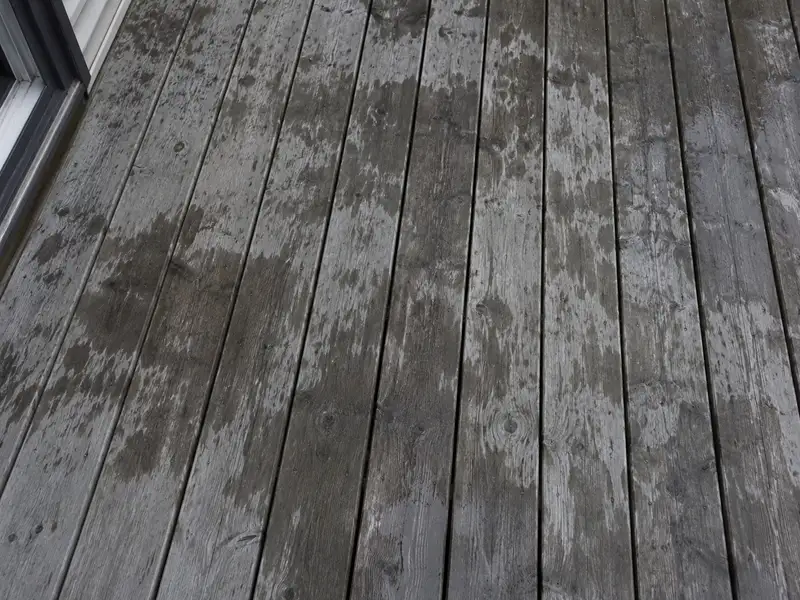
Before recoating, the deck needs a clean. The FPL cautions that aggressive scrubbing or power washing can strip wood off the surface, especially on soft woods like western red cedar.
Our guide to pressure washing decks without damage explains the settings.
What are the most common deck staining mistakes?
Once the weather and the wood are right, most problems come from how the stain goes on:
- Putting on a thick coat to make it last longer. Penetrating stains are meant to soak in. Benjamin Moore says excess stain won’t cure properly and can end up looking like solid colour.
- Stopping in the middle of a board. Benjamin Moore says to keep a wet edge and stop only at natural breaks.
- Skipping a test patch. Colour varies with the wood, and Benjamin Moore suggests trying the stain on a sample of the same wood first.
Doing it yourself or hiring someone
A small deck in good shape is a fair weekend job if you can wait for the right weather and give it a proper clean first.
The hard jobs are decks with peeling paint or solid stain, long stair runs and lots of spindles, and damaged boards that should be fixed before anything goes on. Prep on those takes longer than people expect, and it decides how long the finish lasts.
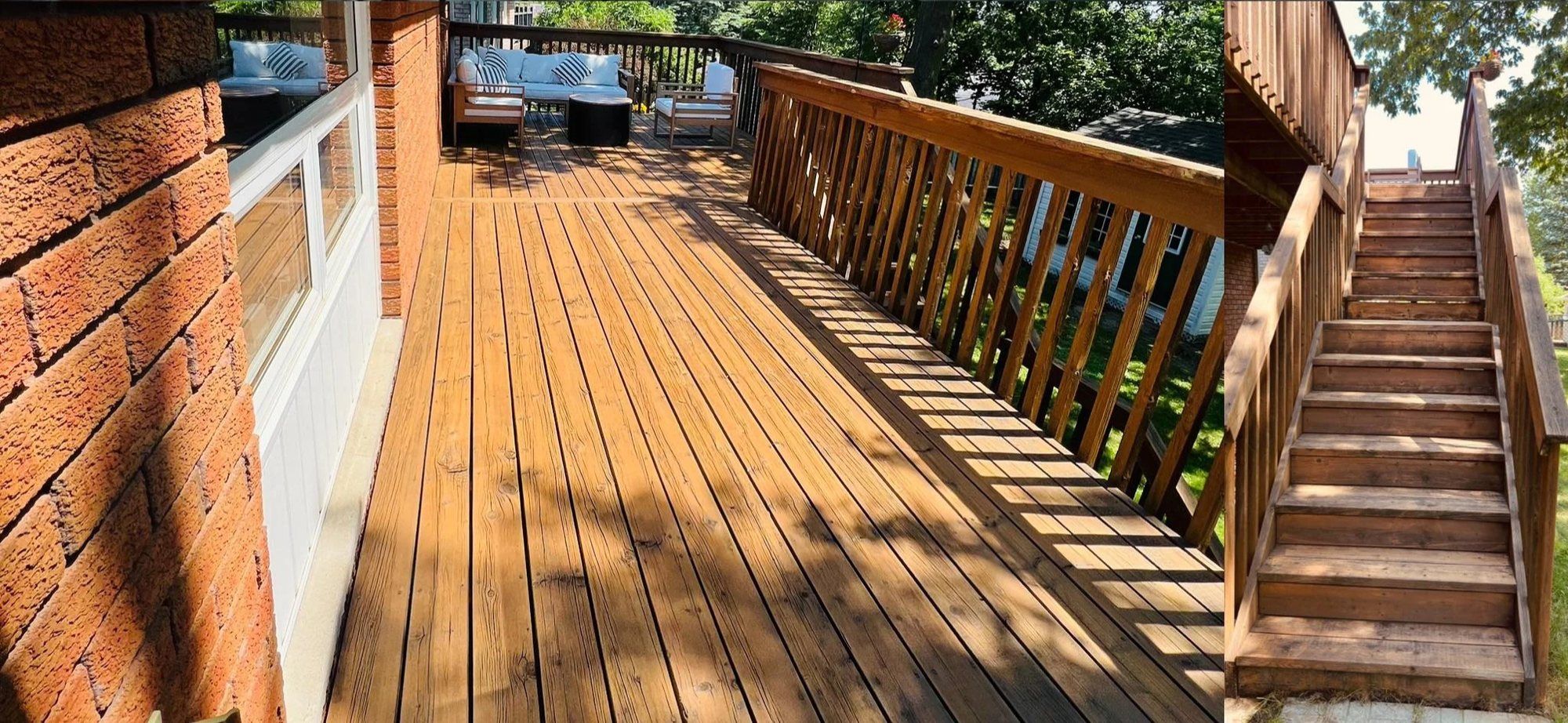
Our deck restoration project shows one with a long staircase and plenty of spindles: grey, weathered boards that were pressure washed, then given a waterproof coating.
We work across Markham and nearby towns such as Richmond Hill. To have us look at your deck, call or text (437) 684-2535 with a few photos, or see our deck staining service page.
The deck staining cost guide covers what pushes the price up or down.
Other questions people ask
When should you not stain a deck?
Don't stain wet wood, and don't start if rain is coming. Skip days below the label's minimum temperature, which is 10 °C for PPG's oil-based deck stain and 4.4 °C for Benjamin Moore's waterborne Arborcoat. Avoid hot boards in full sun and late afternoons when dew is likely. New pressure-treated wood that still beads water isn't ready yet.
Can you put deck stain over deck paint?
Not a penetrating stain. Semi-transparent stains have to soak into bare wood, and the U.S. General Services Administration's wood-staining procedure says not to apply them over paint, solid stain or varnish. A painted deck either gets repainted over well-prepared old paint, or it's stripped or sanded back to bare wood before staining, which is a much bigger job.
How long should new pressure-treated wood dry before staining?
Until it soaks up water. Wood Preservation Canada says a water repellent or semi-transparent stain can go on once treated wood is dry, and suggests sprinkling water on it: if the drops soak in, it's ready. The USDA Forest Products Laboratory says decking with a factory water repellent may need 2 to 3 months of weathering before stain will absorb.
Is it better to stain or paint a deck?
On the floor boards, a penetrating stain usually holds up better. The USDA Forest Products Laboratory recommends penetrating finishes for decks because paint and solid stain trap moisture and wear through in high-traffic areas, then fail by peeling. It also says paint and solid stain can do well on railings, which don't take foot traffic.
How often should a deck be restained in Ontario?
Plan on every 1 to 2 years for the floor boards. The University of Missouri Extension gives that range for penetrating stains on decks and says light colours last longer than dark ones on flat, exposed surfaces. Railings don't take foot traffic, so they often last longer. When water soaks into the boards instead of beading, it's time.
Can you stain over an old stain without stripping it?
Often, if the old stain is a weathered transparent or semi-transparent one that isn't flaking. Benjamin Moore says its Arborcoat can go over a weathered transparent stain in that state, but anything peeling has to come off first. Match the new product to what's already on the deck, and sprinkle a little water on the boards first: if it soaks in, a new coat can soak in too.
Sources
- USDA Forest Products Laboratory: Finishes for Wood Decks (Knaebe, revised 2013)
- University of Missouri Extension: Painting ACQ- or CCA-treated lumber
- Benjamin Moore: Arborcoat Waterborne Semi Solid Stain K639 technical data sheet (Canada)
- PPG: REZ Semi-Transparent Oil Deck Stain 77-961 product data sheet (rev. 2002)
- Wood Preservation Canada: Frequently asked questions
- U.S. General Services Administration: Applying a semi-transparent or opaque stain to wood
- Environment and Climate Change Canada (MSC GeoMet): Canadian Climate Normals 1981–2010, Toronto Buttonville A
Related guides and service
- Deck sealer vs stain vs waterproofing: what each does and which your deck needs A deck sealer is a clear water repellent. It soaks in and makes water bead, but on deck boards it lasts about a year.
- How much does deck staining cost? Published ranges and what moves the price Professional deck staining costs US$550 to $1,250 for a typical deck, or $1 to $4 per square foot, in HomeAdvisor's 2026 guide.
- Pressure washing decks, fences and interlock without damage You can pressure wash a deck, fence or interlock in Ontario without damage if the pressure suits the surface.
- Fence painting vs staining: cost, looks and how long each lasts Paint and solid-colour stain form a film on a wood fence and last longest: about 6 to 10 years on smooth pine with a primer and two top coats, according to the USDA Forest Products Laboratory.