Deck sealer vs stain vs waterproofing: what each does and which your deck needs
Short answer
A deck sealer is a clear water repellent. It soaks in and makes water bead, but on deck boards it lasts about a year. A stain adds pigment that blocks the sun, so a semi-transparent stain lasts about 2 to 3 years. Deck waterproofing usually means one of these, since no finish makes wood fully waterproof. On most Ontario decks a semi-transparent stain suits the floor best, applied June to August, when Markham's average lows top 10 °C.
Key numbers
- Clear sealer on deck boards
- About 1 year
- Semi-transparent stain
- 2–3 years
- Best solid stains
- 3–5 years
- Weather to apply
- Above 10 °C for 48 hours
- Wait on new pressure-treated wood
- 30 days
In this guide
At the hardware store, one can says sealer and the next says deck waterproofing. On a wooden deck they do much the same job in different amounts: they slow the water down, and a stain also blocks the sun. Pick by how much colour you want, how often you’re willing to recoat and what’s already on the boards.
We do this work across Markham through our deck staining, sealing and waterproofing service, and this is the answer we’d give you standing on your deck.
What is the difference between a deck sealer and a stain?
A sealer is clear and a stain has pigment. That’s the main difference.
A clear deck sealer is usually a water repellent: an oil or varnish plus a wax, in a solvent that carries them into the wood, according to the USDA Forest Products Laboratory (FPL). Water beads on the surface instead of soaking in.
The better ones are water-repellent preservatives, which add a mildewcide. The FPL says those perform much better, and that plain water repellents often leave the wood blotchy.
A stain adds pigment. The pigment shades the wood and the mildewcide from sunlight, which the FPL says is why stains last longer.
Between clear and opaque you’ll find:
- A toner, sold as a coloured or tinted sealer, has a little pigment and most of the grain shows.
- An oil-based semi-transparent stain has a lot more pigment but still soaks in without forming a layer, so it won’t blister or peel. Waterborne versions are more likely to leave a film.
- A solid stain sits on top as a film, hides the grain and behaves more like paint.
The FPL recommends penetrating finishes for deck floors: sealers, toners and semi-transparent stains.
Film finishes like paint and solid stain trap moisture, wear through where people walk and fail by peeling.
Does deck waterproofing actually make wood waterproof?
No. The FPL’s handbook on exterior finishes (Agriculture Handbook 647) says no coating is ever entirely moisture-proof, however many coats you put on. It only slows the rate at which the wood takes on and loses water.
On a deck that still counts for a lot, because the constant swelling and shrinking is what opens up checks and cracks.
So when a can says waterproofing, read it as water repellent. Thompson’s, for example, sells its clear sealer on protection from water and sun damage, then recommends a fresh coat every year.
True waterproofing is a different product for a different deck. If the deck sits over a room or you want a dry patio underneath, you need a membrane over a solid plywood deck, such as vinyl decking or the elastomeric coatings Handbook 647 describes.
Duradek, for one, calls its vinyl roof-grade waterproof protection with a dry-below system. It recommends untreated tongue-and-groove plywood underneath and only backs it with a written warranty when an authorized Duradek contractor installs it. On a regular board deck, water is meant to drain through the gaps.
How long does each deck finish last?
On a deck floor, more pigment means a longer life, but film finishes trade that for peeling. Here’s what the sources say about each type on horizontal deck boards:
Scroll sideways to see the whole table.
| Finish | What it does | How long it lasts on a deck | The catch |
|---|---|---|---|
| Clear sealer (water-repellent preservative) | Soaks in, water beads, no colour | About 1 year (FPL). Consumer Reports and Thompson’s both say reapply yearly | Doesn’t stop the wood going grey |
| Toner (coloured water-repellent preservative) | Soaks in, light tint, grain shows | Many years where foot traffic is light, against less than a year for a clear sealer (FPL) | Waterborne versions tend to form a thin film |
| Semi-transparent stain | Soaks in, more colour, grain shows | 2–3 years (Consumer Reports). Handbook 647 says light-coloured penetrating stains on decks need redoing every 1 to 2 years | Dark colours show wear sooner (Handbook 647) |
| Solid stain | Film on top, hides the grain | 3–5 years for the best ones (Consumer Reports) | FPL and Handbook 647 advise against it on deck floors because it peels |
| Paint | Thick film on top | Not a good finish for fully exposed decks (Handbook 647) | Peels, then needs scraping and sanding |
Consumer Reports bases its figures on up to three years of testing: pine boards facing south and angled like a roof, on top of its headquarters in Yonkers, New York.
Good to know
Handbook 647 gives a simple test: splash some water on the boards. If it beads up and runs off, the finish is still working. If it soaks in, recoat.
Which finish does your deck need?
Start with what’s on the boards now, then decide how much colour you want.
- New pressure-treated wood. Sprinkle water on it. If it soaks in, a clear sealer or semi-transparent stain can go on. Thompson’s asks for 30 days on new pressure-treated lumber, and the FPL says decking with a factory water repellent may need 2 to 3 months of weathering first.
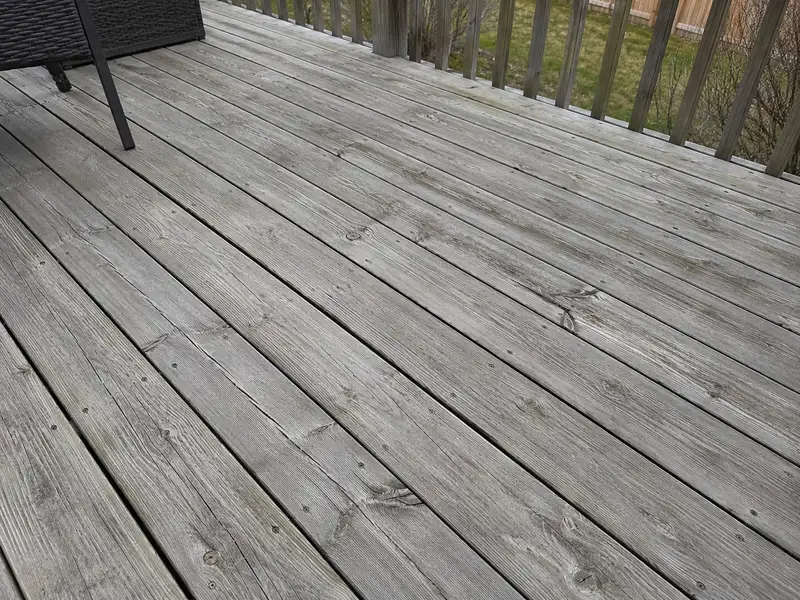
- Grey, weathered wood with no finish left. A semi-transparent stain is usually the right call. The FPL says a deck kept up with clear sealer for years can switch to a semi-transparent stain and do fine.
- You’re unsure. The FPL’s own advice is to use a clear water-repellent preservative first. It’s the easiest finish to reapply, and you can move to a stain next time.
- Solid stain or paint already on the floor. A penetrating product can’t soak through it. You either keep recoating with a film finish after scraping the loose stuff, or strip back to bare wood and switch.
- Railings and spindles. They don’t take foot traffic, so the FPL says paint and solid stain can do well there, even with a penetrating stain on the floor.
Fences raise the same choice, minus the foot traffic. Our fence painting vs staining guide covers them.
Can you put sealer over stain, or stain over sealer?
Not right away. A penetrating sealer has to soak into bare wood, and Thompson’s says not to use its clear sealer on painted or recently stained surfaces.
Going the other way, the FPL says a semi-transparent stain may not absorb into wood recently treated with a water-repellent preservative, and suggests letting it weather for 2 to 3 months.
Cans sold as stain and sealer in one can be anything from a toner to a solid stain, so check the label for how much colour it has. Handbook 647 notes that some penetrating stains already contain a water repellent.
Can you waterproof a deck in October?
Usually not, and that catches a lot of people out, because October is when deck waterproofing gets searched most. The problem is the nights.
Thompson’s asks for the surface and air to stay above 10 °C for 48 hours: while you apply it and for 48 hours afterwards. It also wants no rain forecast for 24 hours.
At the Buttonville station in Markham, Environment Canada’s 1981–2010 normals give October an average low of 3.6 °C and about 7 nights at or below freezing.
Watch out
A warm October afternoon isn’t enough. Those 48 hours include two nights, and an October night in Markham rarely stays above 10 °C. Clear sealers and stains have the same problem, so this isn’t a reason to pick one over the other.
If your deck is soaking up water this fall, here’s what to do instead:
- Wash it, gently.
- Clear the leaves off so the boards can dry over winter.
- Plan the coat for late May to early September.
Our deck staining guide has the month-by-month weather table and the drying rules.
What are the most common sealing and staining mistakes?
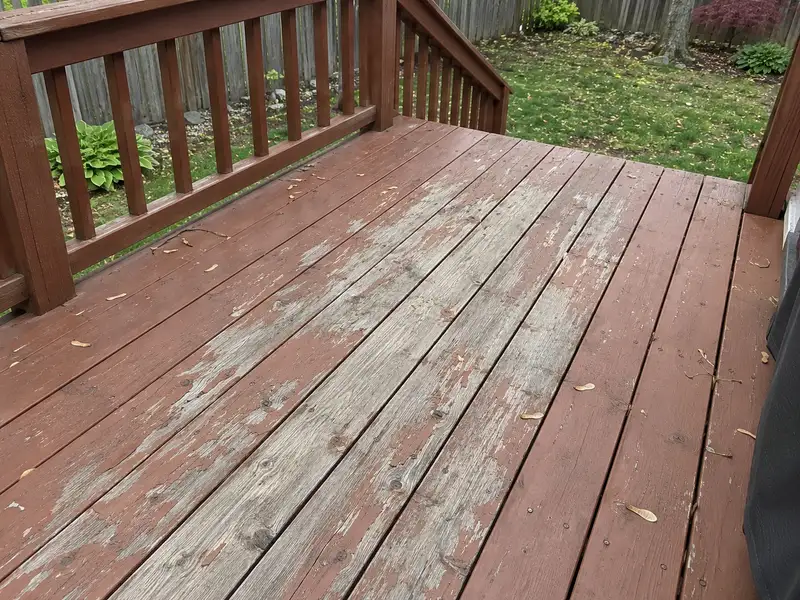
Most failures come from prep and timing rather than the product:
- Coating wet wood. The FPL says to allow at least 2 warm, windy days of drying after cleaning with a bleach solution.
- Putting clear sealer on and expecting the colour to last. Without pigment, little stops the sun greying the wood.
- Laying it on thick. Penetrating finishes are meant to soak in, and the FPL notes that some sealers leave the deck oily until they absorb.
- Rolling a semi-transparent stain over old solid stain or paint. Handbook 647 says penetrating stains aren’t effective over either.
- Power washing too hard. The FPL warns that aggressive scrubbing or power washing removes wood from the surface, especially on soft cedar. Our guide to pressure washing decks without damage has safer settings.
- Lap marks. The FPL notes that overlapping semi-transparent stain onto a section that’s already done leaves darker stripes. Work a few boards at a time along their full length.
When is it worth calling someone?
A sound deck with no old finish is a fair DIY job if you can wait for the weather.
We’d suggest getting help when the old finish is peeling and has to come off, when boards are loose or soft, or when there are long stair runs and dozens of spindles. Prep is most of the work on those decks, and it decides a lot about how long the new coat lasts.
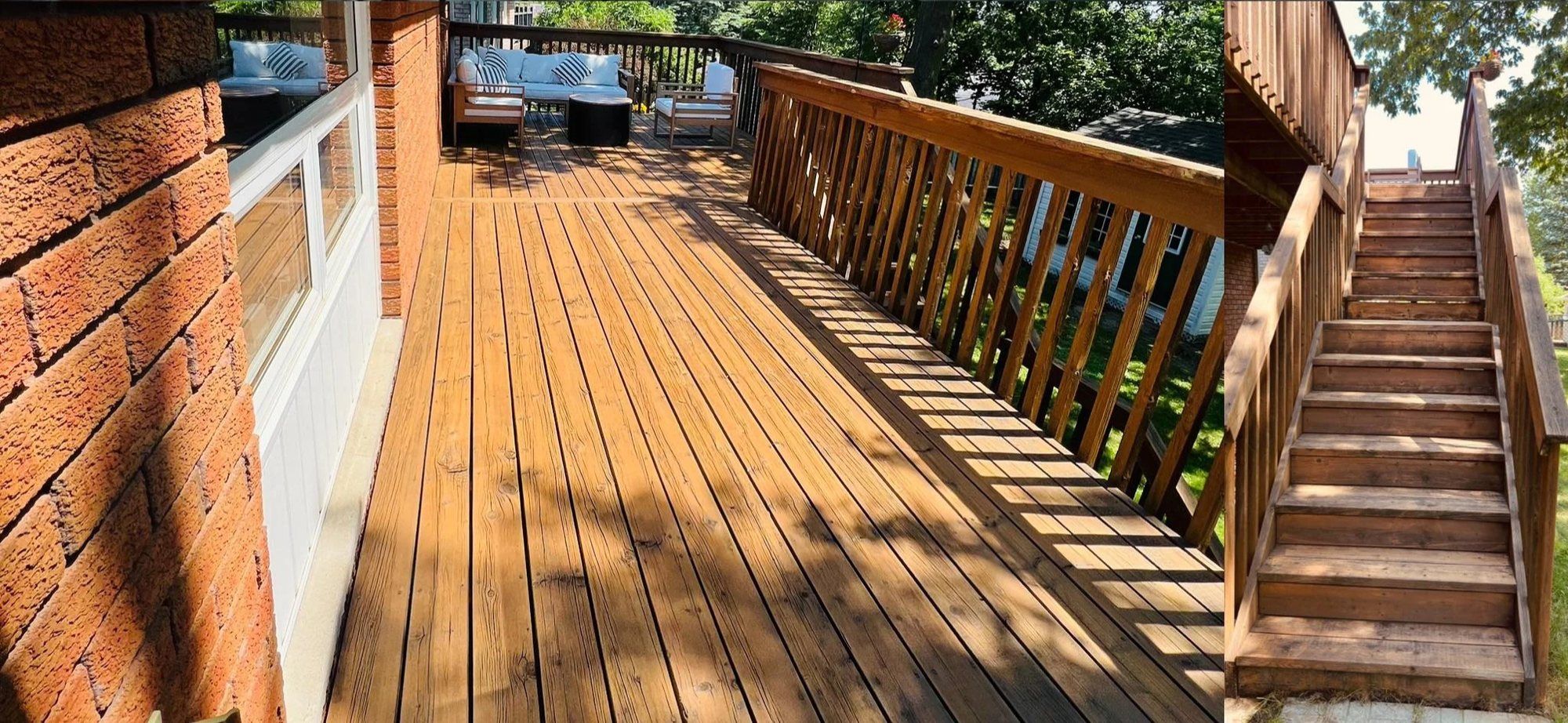
Our deck restoration project shows the kind of job we mean: a grey, weathered deck with a long staircase, pressure washed and then given a waterproof coating.
If yours looks like the before photo, call or text (437) 684-2535 with a couple of photos, or see our deck staining and waterproofing service. For published price ranges and worked examples, read how much deck staining costs.
Other questions people ask
Is it better to stain or water seal a deck?
For most decks, stain. A clear sealer keeps water out but has no pigment to block the sun, so the USDA Forest Products Laboratory gives it about a year on exposed deck boards. A semi-transparent stain soaks in the same way and lasts longer, about 2 to 3 years in Consumer Reports' tests. A sealer still makes sense if you're unsure (the FPL suggests starting with one and switching later) or if you like bare wood and don't mind recoating every spring.
Can you make wood 100% waterproof?
No. The Forest Products Laboratory's handbook on exterior finishes says no coating is ever entirely moisture-proof. A finish only slows down how fast the wood takes on and gives off water. That's still worth a lot on a deck, because slower swelling and shrinking means fewer cracks, checks and raised grain. Keeping the finish up matters more than finding a product with waterproof on the label.
How can I waterproof the floor of my deck?
On a regular board deck, clean it, let it dry right through, then put on a penetrating water repellent or semi-transparent stain and renew it when water stops beading. Water will still drain between the boards. If you need a dry space underneath, or the deck sits over a room, that takes a membrane system such as vinyl decking over plywood, installed by a contractor the maker has authorized.
What is the best deck coating for an old deck?
It depends on what's on it now. A weathered deck with bare grey wood takes a semi-transparent stain well, and the Forest Products Laboratory says even a deck kept up with clear sealer for years can switch to one. If the deck already has paint or solid stain, a penetrating finish can't soak in, so you either recoat with a film finish or strip back to bare wood first.
How often does a clear deck sealer need reapplying?
About once a year. Thompson's recommends yearly reapplication for its clear wood sealer, and the Forest Products Laboratory gives about a year on exposed deck boards. Pigmented stains last longer. Handbook 647 suggests spring for renewing a clear finish and gives a simple test: splash some water on the boards. If it beads up and runs off, the finish is still working. If it soaks in, recoat.
Sources
- USDA Forest Products Laboratory: Finishes for Wood Decks (Knaebe, revised July 2013)
- USDA Forest Service: Finishing Wood Exteriors, Agriculture Handbook 647 (Cassens and Feist)
- Consumer Reports: Best wood stains of 2026 (updated May 28, 2026)
- Thompson's WaterSeal: Clear Wood Sealer product page and directions
- Duradek: Waterproofing deck system
- Duradek: Installation considerations (plywood subsurface)
- Environment and Climate Change Canada (MSC GeoMet): Canadian Climate Normals 1981–2010, Toronto Buttonville A
Related guides and service
- Deck staining in Ontario: when to stain, when not to, and which stain In Ontario, deck staining goes best from late May to mid-September, on wood that's dry right through, with no rain in the forecast.
- How much does deck staining cost? Published ranges and what moves the price Professional deck staining costs US$550 to $1,250 for a typical deck, or $1 to $4 per square foot, in HomeAdvisor's 2026 guide.
- Pressure washing decks, fences and interlock without damage You can pressure wash a deck, fence or interlock in Ontario without damage if the pressure suits the surface.
- Fence painting vs staining: cost, looks and how long each lasts Paint and solid-colour stain form a film on a wood fence and last longest: about 6 to 10 years on smooth pine with a primer and two top coats, according to the USDA Forest Products Laboratory.