How much does deck staining cost? Published ranges and what moves the price
Short answer
Professional deck staining costs US$550 to $1,250 for a typical deck, or $1 to $4 per square foot, in HomeAdvisor's 2026 guide. Fixr's 2025 guide gives $2 to $5 per square foot. We couldn't find a Canadian price survey, so for a deck in Markham or elsewhere in Ontario, convert to Canadian dollars and add 13% HST. Prep, railings and stairs move the total more than the stain does.
Key numbers
- Typical deck, professional
- US$550–$1,250 (HomeAdvisor, 2026)
- Per square foot
- US$1–$4 (HomeAdvisor) or $2–$5 (Fixr)
- Railings, handrails and posts
- US$4–$12 per linear ft (Fixr, 2025)
- Stain coverage per coat
- 150–400 sq ft per gallon
- Recoat every
- 2–3 years
In this guide
Professional deck staining costs about US$550 to $1,250 for a typical deck in HomeAdvisor’s 2026 guide, or $1 to $5 per square foot across the published guides. In Ontario, add the exchange rate and 13% HST. The stain itself is a small part of that, since two or three cans cover most decks.
What you’re really paying for is the washing, sanding and drying before the stain goes on, the slow work on railings and stairs, and someone who knows not to start when dew is coming. So two quotes for the same deck can be far apart.
Below are the ranges and some worked numbers to check a quote against. We don’t publish our own prices, because every deck is in different shape, but we’ll quote yours through our deck staining and waterproofing service.
How much does it cost to stain a deck?
The published guides put it at about $1 to $5 per square foot, or roughly $550 to $1,250 for a typical deck. We couldn’t find a Canadian price survey with deck staining figures, so these come from two large American cost guides. Treat them as a rough market picture.
Scroll sideways to see the whole table.
| Source (year) | What it covers | Range (USD) |
|---|---|---|
| HomeAdvisor (2026) | Professional deck staining, total | $550–$1,250 |
| HomeAdvisor (2026) | Staining, per sq ft | $1–$4 |
| HomeAdvisor (2026) | Labour only, per sq ft | $1–$2.50 |
| Fixr (2025) | Staining with light sanding and sealing, per sq ft | $2–$5 |
| Fixr (2025) | Labour only, per sq ft | $1.50–$3 |
| Fixr (2025) | Railings, handrails and posts, per linear ft | $4–$12 |
| HomeAdvisor (2026) | Stain only, per gallon, by type | $20–$120 |
To turn these into a GTA number, convert at the current exchange rate and add Ontario’s 13% HST, which the Canada Revenue Agency lists as the provincial rate.
HomeAdvisor also notes that labour can climb to around $7 per square foot for complex jobs or in places with a higher cost of living.
What does a deck my size cost to stain?
For a plain deck floor in decent shape, Fixr’s size table is a useful starting point. We’ve added how much stain the floor alone needs per coat, using the lowest and highest coverage the manufacturers in our sources publish (150–400 sq ft per gallon, the 3.78 L can).
Scroll sideways to see the whole table.
| Deck size | Floor area | Fixr range (USD, 2025) | Stain per coat (3.78 L cans) |
|---|---|---|---|
| 10 x 16 ft | 160 sq ft | $320–$800 | 1–2 |
| 12 x 20 ft | 240 sq ft | $480–$1,000 | 1–2 |
| 16 x 20 ft | 320 sq ft | $640–$1,600 | 1–3 |
| 20 x 20 ft | 400 sq ft | $800–$2,000 | 1–3 |
Railings change the math quickly. Take a 12 x 20 ft deck with 40 linear feet of railing:
Scroll sideways to see the whole table.
| Part of the job | Fixr rate | Cost (USD) |
|---|---|---|
| Floor, 240 sq ft | $2–$5 per sq ft | $480–$1,000 |
| Railing, 40 linear ft | $4–$12 per linear ft | $160–$480 |
| Total | Floor plus railing | $640–$1,480 |
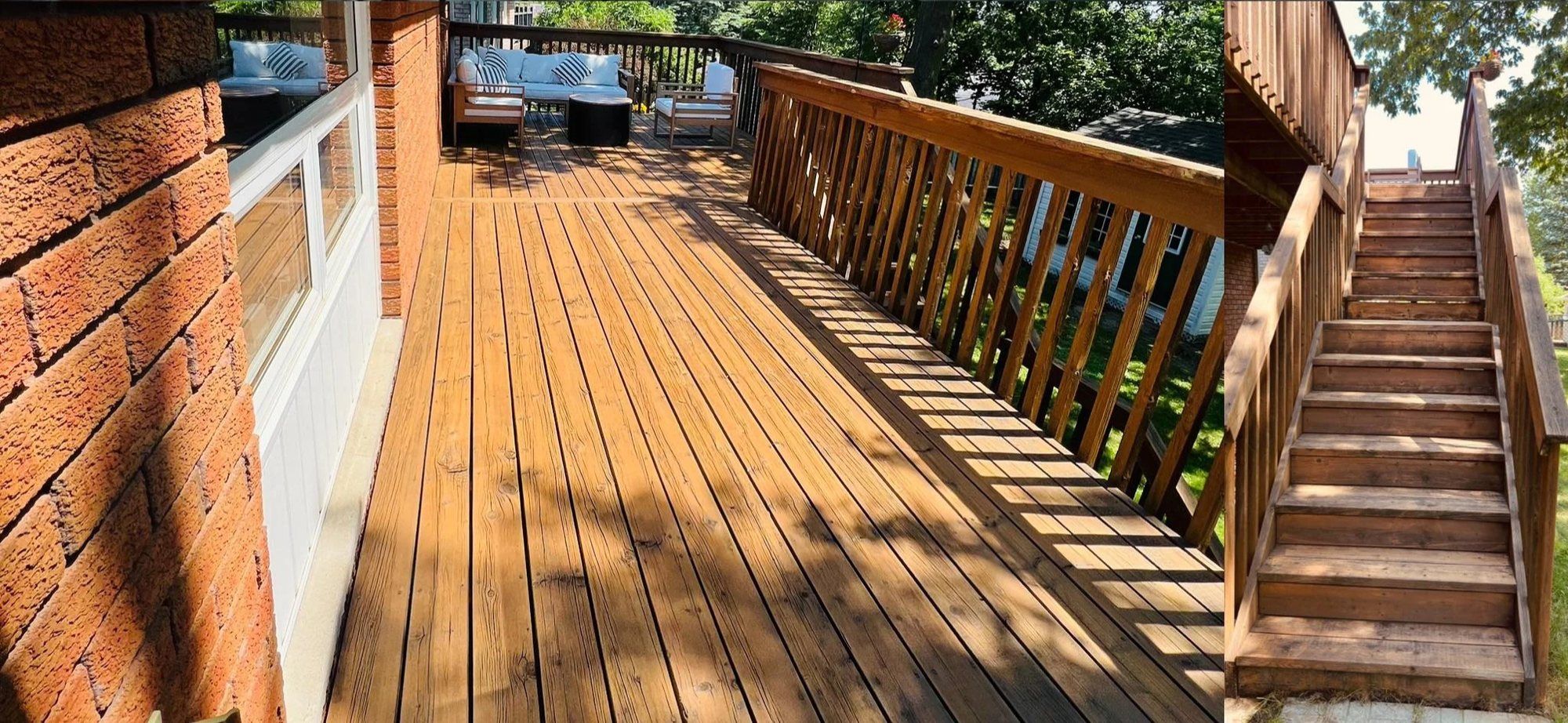
That’s before any heavy prep, exchange or tax. Fixr prices stairs like the floor, at $2 to $5 per square foot, though in practice they’re slower to coat because of all the edges.
What adds the most to the deck staining cost?
The condition of the wood matters more than the size of the deck. A sound deck that only needs a wash and a coat sits at the bottom of the ranges.
A deck with peeling paint or flaking solid stain costs much more, because the old coating has to come off first. Fixr lists prep separately, per square foot:
Scroll sideways to see the whole table.
| Prep step | Fixr range (USD per sq ft) |
|---|---|
| Cleaning | $0.25–$0.50 |
| Power washing | $0.30–$0.40 |
| Stripping old finish | $1–$3 |
| Sanding | $1–$4 |
HomeAdvisor puts stripping old paint much higher, at $9 to $12 per square foot. That gap shows how much stripping depends on what’s on the wood.
What else moves a quote:
- Railings, spindles, lattice and built-in benches, which are slow to coat by brush.
- Several levels or long staircases.
- Grey, weathered boards. Benjamin Moore’s Arborcoat data sheet says weathered wood must be treated until a sound surface is reached, with loose fibres removed, before staining.
- Loose or rotten boards that need fixing first. That’s deck and fence repair work and is often quoted on its own.
- Stain choice. HomeAdvisor lists water-based stains at $20 to $90 a gallon and oil-based at $35 to $120. On most decks that’s a small share of the total.
How much stain do you need?
Coverage depends on the product and the wood:
- PPG lists 150 to 250 sq ft per gallon for its REZ semi-transparent oil stain.
- Sherwin-Williams says one gallon typically covers about 250 to 350 sq ft.
- Benjamin Moore lists 300 to 400 sq ft per 3.79 L for Arborcoat semi solid.
Sherwin-Williams also says most decks need one to two coats. To work out your own number:
- Multiply the deck’s length by its width to get the floor area.
- Add the stairs and the railings, which have more surface than people expect.
- Divide the total by the coverage on the can. That’s the number of cans for one coat.
- Multiply by the number of coats, then round up.
Worked example: a 12 x 20 ft deck is 240 sq ft. At 200 sq ft per can, one coat takes about 1.2 cans and two coats about 2.4.
Good to know
Buy three cans for that floor, not two and a half, and more if you’re doing the railings and stairs too. Rough, dry boards soak up more than the label suggests, so plan at the low end of the coverage range.
When can you stain a deck in Ontario?
Only when the wood is dry and the weather stays inside the label’s limits for the whole drying time. Get that wrong and you pay for the same job twice.
Scroll sideways to see the whole table.
| Source | What the label or guide asks for |
|---|---|
| PPG REZ oil stain | Air, surface and product above 10°C. Don’t stain late in the day, when dew forms. |
| Benjamin Moore Arborcoat | Down to 4.4°C. Wood below 15% moisture. 48 hours before normal foot traffic. |
| Sherwin-Williams | Wait 24 to 48 hours after rain. |
Environment Canada’s 1991–2020 normals for the Buttonville station in Markham put October’s average low at 4.3°C, with about 10 nights at or below 2°C. So late May through mid-September is the easy stretch.
Our deck staining guide has the month-by-month table and the stain types.
New pressure-treated decks need time before any stain goes on. Viance, which makes wood preservatives, says treated wood is typically ready about 60 days after installation. Sherwin-Williams is more cautious and says to wait at least 6 months.
Good to know
Viance’s dryness check is simple. Sprinkle a few drops of water on the boards. If they soak in quickly, the wood is dry enough to take stain.
Common mistakes that cost money later
- Staining damp wood. Arborcoat’s sheet wants the wood below 15% moisture, and the Forest Products Laboratory says to allow at least two warm, windy days of drying after washing a deck with a bleach cleaner.
- Skipping the prep. Both PPG and Benjamin Moore say the surface must be clean and free of mildew, and Benjamin Moore says grey, weathered wood needs treating before it’s stained.
- Laying it on thick. Arborcoat’s sheet warns that too much stain prevents a proper cure, and PPG calls for thin coats.
- Staining in full sun on a hot afternoon. Both PPG and Benjamin Moore warn against it. Benjamin Moore says direct sun stops the stain from soaking in properly and causes lap marks.
- Pressure washing too hard. The Forest Products Laboratory warns that power washing can strip wood from the surface, especially on soft woods like cedar. A chewed-up surface then needs sanding. See our guide to pressure washing decks, fences and interlock without damage.
Watch out
Don’t put a penetrating stain over paint. Benjamin Moore’s sheet says the wood must be absorbent so the stain can soak in, and paint blocks that. The paint has to be stripped first, and HomeAdvisor prices stripping old paint at $9 to $12 per square foot.
How often will you pay for it?
Plan on a recoat every 2–3 years. That’s the interval both Sherwin-Williams and Fixr give for wood decks, and it depends on sun, foot traffic and the product.
The floor takes the foot traffic, so it usually wears before the railings. The Forest Products Laboratory notes that railings don’t need the abrasion resistance the floor does.
Recoating just the floor in between can push back the full job. Recoating before the old finish fails is cheaper than stripping it after it peels.
Should you hire a pro or do it yourself?
A small, sound deck on a calm weekend is a fair DIY job. HomeAdvisor puts materials for a DIY staining job at $20 to $250, plus a pressure washer if you don’t own one, which it says rents for $35 to $175 a day. Most of the skill is in the prep and the timing.
It’s worth getting a quote when:
- the old finish is peeling,
- the deck has more railing than floor,
- there are boards to replace, or
- the deck is high off the ground.
On those jobs, most of the cost is prep. For a look at a finished job, see our deck restoration project, which was pressure washed and given a waterproof coating.
If you’d like a price for yours, call (437) 684-2535 or text us a few photos of the deck. We work across Markham and nearby towns such as Richmond Hill, and you can also ask through our deck staining service page.
We’ll look at the wood, the railings and the old finish before giving you a number.
If you’re pricing other yard work at the same time, our guide to landscaping costs in Markham covers the rest, and fence painting vs staining helps if the fence needs doing too.
Other questions people ask
What's the average cost of staining a deck?
HomeAdvisor's 2026 cost guide puts professional deck staining between US$550 and $1,250, and Fixr's 2025 guide says the average homeowner spends about $750 to clean, lightly repair, stain and seal a 14 x 18 ft deck. Both are American figures in US dollars. For a GTA deck, convert at the current exchange rate, add 13% HST and expect railings, stairs and heavy prep to push the number up.
Is it cheaper to stain or paint a deck?
Staining is usually cheaper. Fixr lists deck staining at $2 to $5 per square foot and deck painting at $5 to $9, nearly twice as much. On the deck floor, the USDA Forest Products Laboratory recommends a penetrating stain, because paint and solid stain tend to trap moisture and peel there. Going back from paint to stain later means stripping first. Our fence painting vs staining guide covers the same choice for fences.
How much stain do I need for my deck?
Divide the area by the coverage on the can, per coat. Coverage varies a lot: PPG lists 150 to 250 sq ft per gallon for its REZ oil stain, Sherwin-Williams says about 250 to 350 is typical, and Benjamin Moore lists 300 to 400 for Arborcoat semi solid. Rough, weathered wood drinks more, so plan at the low end and buy one extra can.
Is it cheaper to stain a deck yourself?
Usually, if the deck is sound. HomeAdvisor puts materials for a DIY staining job at $20 to $250, plus $35 to $175 a day to rent a pressure washer if you don't own one. Its range for professional staining is $550 to $1,250. Those are US figures before exchange and 13% HST. Peeling finishes, lots of railing and boards to replace are where hiring pays off.
How much does it cost to strip and stain a deck?
Stripping is priced on top of the staining. Fixr's 2025 guide lists stripping an old finish at $1 to $3 per square foot and staining at $2 to $5, so stripping and staining a 240 sq ft deck floor comes to roughly $720 to $1,920 before railings. HomeAdvisor's 2026 guide puts stripping old paint much higher, at $9 to $12 per square foot. Both are US figures, so convert them and add 13% HST in Ontario.
Sources
- HomeAdvisor: What does it cost to stain a deck? (updated June 2026)
- Fixr: Cost to stain a deck (updated January 2025)
- Benjamin Moore: Arborcoat Semi Solid Waterborne Exterior Stain (K639) technical data sheet
- PPG: REZ Semi-Transparent Oil Deck Stain (77-961) product data bulletin (rev. April 2002)
- Sherwin-Williams: How to plan deck staining
- Viance (TreatedWood.com): Staining decks and fences
- Environment and Climate Change Canada: Canadian Climate Normals 1991–2020, Buttonville (Airport)
- USDA Forest Products Laboratory (Knaebe, 2013): Finishes for wood decks
- Canada Revenue Agency: GST/HST rates by province
Related guides and service
- Deck staining in Ontario: when to stain, when not to, and which stain In Ontario, deck staining goes best from late May to mid-September, on wood that's dry right through, with no rain in the forecast.
- Deck sealer vs stain vs waterproofing: what each does and which your deck needs A deck sealer is a clear water repellent. It soaks in and makes water bead, but on deck boards it lasts about a year.
- Pressure washing decks, fences and interlock without damage You can pressure wash a deck, fence or interlock in Ontario without damage if the pressure suits the surface.
- Landscaping costs in Markham: what landscapers charge per hour in Ontario Landscape Ontario's 2022 charge-out rate survey puts landscape labourers at $55 to $90 an hour and landscape technicians at $75 to $110.