How to fix brown spots and bare patches in your lawn: snow mould, dog spots, salt and drought
Short answer
Most brown spots on lawns in Ontario come from snow mould after the melt, road salt along driveways, dog urine, summer drought, hairy chinch bugs in July and August, or grubs in fall. Tug the grass first. If it stays rooted, it may only be dormant and should start greening up at least 2 weeks after a deep soaking. If it lifts or stays brown, rake it out and reseed (mid-August to mid-September) or patch it with sod.
Key numbers
- Keep dormant grass alive
- About 6 mm (1/4 in) of water a week
- Flush a dog spot
- 3 times the water, within 8 hours
- Chinch bug can test
- More than 20 bugs in a 20 cm can
- Best time to reseed
- Mid-August to mid-September
- Kentucky bluegrass sprouts in
- 14 to 30 days
In this guide
Brown spots on a lawn in Ontario usually come from snow mould, road salt, dog urine, drought, hairy chinch bugs or grubs. Where the patch is, its shape and the month it showed up will usually tell you which. Pull on the grass before you seed anything: dormant grass is still rooted and comes back with water, while dead grass has to be raked out and replaced with seed or sod.
Sort out the cause before the repair. Seed spread over live chinch bugs or salty soil dies the same way the old grass did.
If a big part of the lawn is gone, that’s a job for our sod installation and lawn repair service.
What is causing the brown spots on my lawn?
Match the spot to the season and where it is. Most of these details come from OMAFRA’s turf guide (Publication 845).
Scroll sideways to see the whole table.
| Cause | When and where | How to recognise it | Usual fix |
|---|---|---|---|
| Snow mould | Early spring as the snow melts, worst where snow sat longest | Matted, bleached, tan or pinkish circles up to 30 cm across, sometimes with grey or pink fuzz at the edge. Grey snow mould leaves tiny hard dots (sclerotia) on dead blades | Rake to dry it out, feed lightly, reseed only what stays dead |
| Road salt | Spring, along the driveway, sidewalk or road | A straw-coloured strip with a sharp line where healthy grass starts, following where snow was piled or plowed | Soak deeply once the ground thaws, then reseed or sod the strip |
| Dog urine | Any time the grass is growing | A round dead spot, often ringed by dark green, fast-growing grass, where the dog (usually a female) goes | Water spots within 8 hours; reseed or patch dead ones |
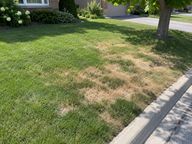
| Drought | July and August, worst in full sun | Whole areas turn tan at once, but the grass stays firmly rooted | Water about 6 mm a week to keep it alive, or wait for rain |
| Hairy chinch bugs | Mid-July to mid-August, in sun, often next to beds or hedges | Fist-sized, sunken, irregular patches that spread. The grass stays rooted and bugs float up in the can test | Water, then reseed in late summer with endophyte-enhanced seed |
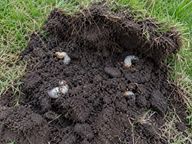
| Grubs | Early fall, spreading into November | Wilted, then yellow, then dead patches, often with skunk or raccoon digging. The turf lifts like a loose carpet with white C-shaped grubs under it | Deal with the grubs, then reseed or sod |
Is my grass dead or just dormant?
Pull on it. If the brown grass is firmly attached and resists, it’s probably dormant or only damaged on top. If it pulls out with no roots, or a whole section peels back, it’s dead.
The University of Wisconsin gives two other signs of life: white tissue at the crown (where blades meet roots) and any green in the leaves. It says Kentucky bluegrass can go 60 days or more without water by letting its leaves die and keeping the crown alive.
That matters in Markham and the rest of the GTA, because OMAFRA’s suggested seed mix for a sunny Ontario lawn is 80 to 100 per cent Kentucky bluegrass. Foot traffic cuts the survival time a lot, so keep people and dogs off a brown lawn in a dry spell.
Watch out
OMAFRA notes that chinch bug damage also stays rooted and is often mistaken for drought. Rooted brown patches in sunny spots in late July, while the rest of the lawn is green, call for the can test below.
How do you fix snow mould?
Rake it. Snow mould is a fungus that grows under long snow cover, and OMAFRA says the grey kind stops being active once the snow melts.
Rake the matted grass so it dries out, then feed the area lightly to push new growth. Iowa State Extension says snow mould spots usually green up, just more slowly than the rest of the lawn. Reseed or patch only the spots that are still bare once the rest of the lawn is green.
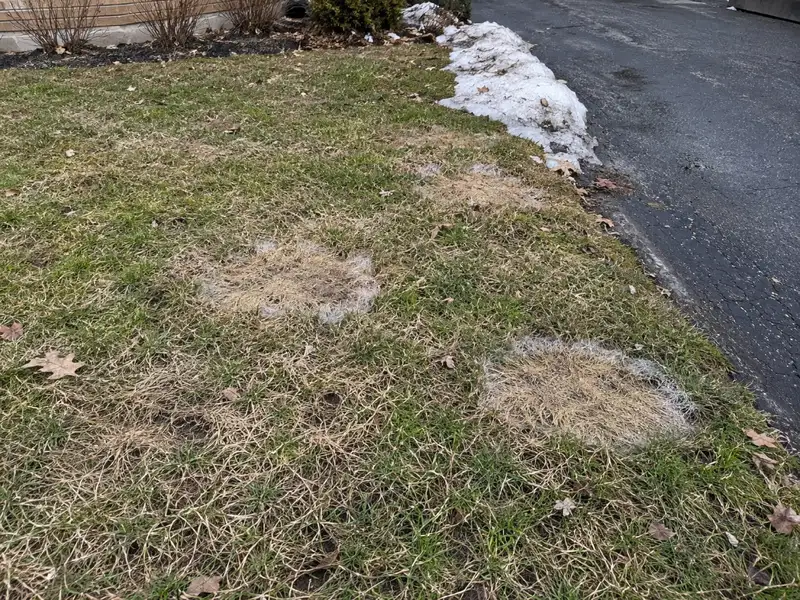
OMAFRA ties heavy grey snow mould damage to snow cover lasting two months or more. That’s why it tends to show where snow sat longest, such as under the pile at the end of the driveway.
To head it off next winter, OMAFRA’s advice is to:
- Keep mowing until the grass stops growing.
- Keep thatch down.
- Rake leaves off the lawn.
- Stop applying nitrogen at least six weeks before the grass goes dormant.
Our fall lawn care guide covers the fall side of this.
How do you repair salt damage along a driveway?
Flush the salt out first, then reseed or sod. The University of Minnesota notes that salt injury shows up after the melt as dead strips beside pavement.
Iowa State Extension recommends heavy watering once the ground thaws, so the salt moves below the root zone. If spring is dry, give the strip a few deep soakings, then rake out the dead grass and reseed or lay sod.
Good to know
Next winter, pile salty snow where the meltwater won’t run across the lawn. Iowa State also suggests mixing sand with salt (about 50 parts sand to 1 part salt), and notes that calcium, potassium and magnesium chlorides are easier on plants than sodium chloride.
How do you fix dog spots in the lawn?
Water them fast, and reseed the ones that died. In the middle of the spot the urine was strong enough to burn (Missouri’s turf researchers put it down to ammonia overload). Around the edge it was weaker and worked more like fertilizer, which is the dark green ring.
They found that about 3 times as much water as urine, applied within 8 hours, avoids the burn. After 12 hours it’s too late.
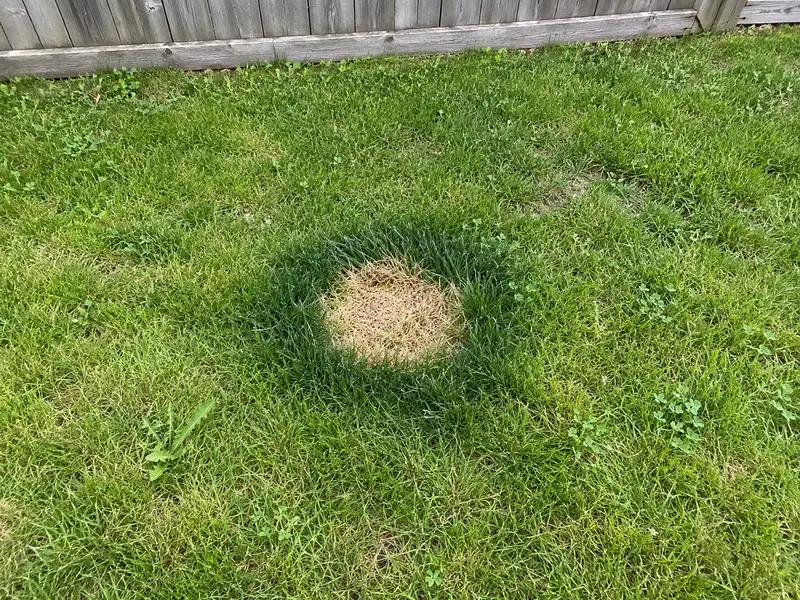
Mild burns often grow back on their own. Dead ones need raking, a little topsoil, and seed or sod.
The same Missouri work found Kentucky bluegrass very sensitive to urine, and tall fescue and perennial ryegrass the most resistant. A seed mix with those grasses holds up better in a dog’s favourite corner.
What should you do about drought patches?
Pick one: water just enough to keep the crowns alive, or enough to keep the lawn green.
The University of Wisconsin says brown grass needs only about 6 mm (1/4 in) of water a week, or half an inch every other week, to stay alive. Watering much more than that wakes the grass up, and green grass uses about an inch (25 mm) a week.
In Markham, lawn watering from June 1 to September 30 is limited to odd or even days by house number, in either a 6 to 9 a.m. or a 6 to 9 p.m. window (not both). New sod is exempt for two months after it’s laid. Check the City of Markham’s water use bylaw before you set a sprinkler.
If a patch is still brown three weeks after the soil has been soaked, it’s probably dead. Reseed it in the late-summer window.
Is it chinch bugs?
Do a can test if the brown patch is in a sunny, dry spot in July or August. This is OMAFRA’s method:
- Cut both ends off a large can, about 20 cm across.
- Twist it into the turf at the edge of the brown patch, where brown meets green.
- Fill it with water and wait 2 to 5 minutes.
- Count what floats up. More than 20 chinch bugs in the can means damage is likely.
The adults are black and white and only about 3 mm long. Newly hatched nymphs are bright red, and older nymphs have a white band across the back.
If the can comes up empty and the dead turf peels back like a loose carpet, look for grubs instead. Our lawn grubs guide covers how to check, the numbers that matter and what you can legally use on them in Ontario.
When you reseed after chinch bugs, check the seed label for endophytes. OMAFRA notes that endophyte-enhanced perennial ryegrass, tall fescue and fine fescue resist their feeding.
When should you seed, and when should you sod?
Seed small, thin or dead patches from mid-August to mid-September. That’s the window Iowa State Extension gives for renovating a thin lawn, and the soil is still warm enough for seed to come up quickly.
Seed needs daily water until it’s up, and some of it is slow. UC’s turf program lists these germination times:
Scroll sideways to see the whole table.
| Grass | Days to germinate |
|---|---|
| Kentucky bluegrass | 14 to 30 |
| Fine fescues | 7 to 14 |
| Perennial ryegrass | 5 to 10 |
Sod makes more sense in spring, for salt or snow mould damage you want gone before summer. It also suits places where seed struggles: slopes, the dog run, the driveway strip.
Our guide to watering new sod has the schedule for the first weeks. The steps below work for either.
Common mistakes with brown spots
- Seeding before you know the cause. Grubs and chinch bugs eat new grass as happily as old.
- Spreading seed on top of dead thatch. The seed needs to touch soil, so rake down to it.
- Seeding in late October. Kentucky bluegrass needs 14 to 30 days just to sprout, so it gets very little growing time before the ground freezes. Lay sod instead, or wait until next August.
When is it worth calling a pro?
Call someone when the patches cover a big part of the lawn, or when you’ve reseeded twice and it hasn’t held. The same goes for ground that’s low, compacted clay or holds water, because seed can’t fix a grade problem. A few dog spots or a salt strip are a fine weekend job.
We cut out dead areas, prepare the soil and lay new sod across Markham, Richmond Hill and nearby. See our lawn repair and sod installation service for what that involves.
Call (437) 684-2535 or text us a couple of photos of the lawn for a free quote. For what to do the rest of the year, see our Ontario lawn care calendar.
Step by step
- Check whether the grass is alive. Pull gently on a handful of brown grass. If it stays firmly rooted and you can find white or green tissue at the base, it's dormant or only damaged on top. Give it water and two or three weeks before you dig anything up.
- Deal with the cause first. Flush salt or urine with a deep soaking, rake matted snow mould, and check for chinch bugs or grubs before you seed. New grass on top of an active problem dies the same way.
- Rake out the dead grass. Scratch out the dead material with a stiff rake until you see bare soil, then loosen the top few centimetres so the seed or sod has something to root into.
- Level the spot with topsoil. Fill the patch with screened topsoil so it sits level with the lawn around it. A low spot holds water and a high one dries out first.
- Seed it or lay a piece of sod. Spread seed that matches your lawn and press it in with the back of the rake or your foot, or cut a sod piece to fit tight against the edges. Seed takes best from mid-August to mid-September.
- Keep it moist until it's growing. Water lightly at least once a day until the seed is up, or every morning until the sod has rooted. Kentucky bluegrass can take 14 to 30 days to sprout, so don't give up after a week.
- Mow once the new grass is established. Start mowing when the new grass is tall enough to cut, and raise the mower gradually to about 7.5 cm. Keep feet and dogs off the patch until it holds when you tug it.
Other questions people ask
Will a lawn recover from a brown patch?
Often, if the grass is dormant rather than dead. Drought-brown Kentucky bluegrass keeps its crowns alive, and the University of Wisconsin says it starts greening up at least two weeks after the soil is soaked. Snow mould spots and mild dog spots usually grow back too, more slowly. Grass killed outright by grubs, chinch bugs or heavy salt won't come back. If a patch is still brown three weeks after a good soaking, rake it out and reseed or sod it.
How do I treat brown patches in my lawn?
Find the cause before you buy anything. Tug the grass: if it lifts like carpet, look for grubs; if it's rooted and the patches are in sun in July or August, do a can test for chinch bugs. Strips by the driveway point to salt, round spots with a dark green ring to dogs, and matted patches after the melt to snow mould. Fix the cause, then rake out the dead grass and reseed or sod.
What does lawn fungus look like?
In spring it's usually snow mould. OMAFRA describes grey snow mould as bleached, roughly circular patches up to 30 cm across (often 10 to 20 cm) that show up as the snow melts, often with a whitish-grey ring of fungus at the edge. Pink snow mould patches are orange to reddish-brown, up to 25 cm, with white to pink fuzz around the rim. In summer, dollar spot shows as small straw-coloured patches up to 5 cm wide.
Is it better to seed or sod a bare patch?
Seed is cheaper and blends in well for small spots if you can water it every day and wait. It works best from mid-August to mid-September. Sod gives you grass right away and suits patches where people or dogs walk, slopes where seed washes off, and spring repairs after salt or snow mould. A sod patch also has to be watered daily until it roots, usually in 10 to 14 days.
How do you stop dog urine killing the grass?
Water the spot soon after the dog goes. University of Missouri turf research found that about three times as much water as urine, applied within eight hours, can give a fertilizer effect rather than a burn, and that burns develop when dilution waits past 12 hours. The same work found Kentucky bluegrass very sensitive to urine, while tall fescue and perennial ryegrass were the most resistant.
Sources
- Ontario Ministry of Agriculture, Food and Rural Affairs: Integrated Pest Management for Turf (Publication 845)
- University of Wisconsin Extension: Keeping your grass alive during periods of extended drought (Doug Soldat, 2012)
- University of Missouri IPM: Beautiful lawns and pets, not exactly a match made in heaven (Brad Fresenburg, 2010)
- University of Minnesota Extension: Diagnosing brown or dead areas in lawns
- Iowa State University Extension: Using deicing salts in the home landscape
- Iowa State University Extension: Why aren't snow-covered lawn areas greening up in the spring?
- Iowa State University Extension: Overseeding a lawn
- Iowa State University Extension: How should I water a newly sodded lawn?
- University of California IPM: Germination times for turfgrass seed
- City of Markham: Water use bylaw
Related guides and service
- Lawn grubs in Ontario: signs, skunk and raccoon damage, and what you can legally use Most lawn grubs in Ontario are European chafer larvae. They eat grass roots from late September into November and again in spring, so dead turf lifts like a carpet and skunks and raccoons dig it up.
- How to get rid of creeping Charlie, crabgrass, clover and dandelions under Ontario's pesticide ban Ontario's cosmetic pesticide ban means the 2,4-D and triclopyr sprays in American lawn advice can't go on a home lawn here.
- Fall lawn care in Ontario: overseeding, aeration and repair In Ontario, fall lawn work runs from late August into November. Overseed thin areas from mid-August to mid-September, with early September the sweet spot, ideally right after core aerating damp soil.
- Ontario lawn maintenance schedule: what to do each month A lawn maintenance schedule for Ontario and the GTA runs from April to November.