Ontario lawn maintenance schedule: what to do each month
Short answer
A lawn maintenance schedule for Ontario and the GTA runs from April to November. Rake gently in April, mow at about 7.5 cm from spring on, feed in late May or early June, and water about 2.5 cm once a week in summer or let the grass go dormant. Overseed and aerate from mid-August to mid-September, feed again in fall, and keep mowing until the grass stops growing.
Key numbers
- Mowing height
- About 7.5 cm
- Summer watering
- 2.0 to 2.5 cm, once a week
- Best time to overseed
- Mid-August to mid-September
- Nitrogen per feeding
- Up to 0.5 kg per 100 m²
- Markham watering rules
- June 1 to September 30
In this guide
This lawn maintenance schedule for Ontario covers the cool-season grasses in the usual lawn mix: Kentucky bluegrass, fine fescues and perennial ryegrass. A GTA lawn needs very little from December to March and a lot from April to November. Most of the work that decides how it looks next year happens in two short windows: late May into June, and mid-August into September.
Miss the fall window and thin spots tend to fill in with weeds instead of grass.
If you’d rather hand the weekly cutting to someone else, that’s what our lawn mowing and lawn care service covers.
What is the recommended lawn maintenance schedule for Ontario?
Rake in April, mow at 7.5 cm from May on, feed in late May or early June and again in late summer or fall, and overseed and aerate from mid-August to mid-September.
Here’s the full lawn care calendar for Markham and the rest of the GTA. Dates shift a week or two with the weather, so go by what the grass is doing.
Scroll sideways to see the whole table.
| Month | Main jobs | Why |
|---|---|---|
| December to March | Not much. Get the mower blade sharpened before spring. | PLCAO: a sharp blade makes a clean cut that seals quickly and resists disease. |
| April | Rake gently once the lawn is dry. Lift matted patches. Clear winter debris. First mow once the grass is growing. | OMAFRA advises raking matted snow mould patches in spring so they dry out. |
| May | Mow at about 7.5 cm. Aerate compacted areas. Patch bare spots. | TRCA recommends a 7.5 cm cut. OMAFRA’s calendar puts home lawn aeration in May and September. |
| June | Feed in late May or early June. Mow weekly. Water deeply if it’s dry. | Landscape Ontario’s suggested spring feeding. Markham’s watering rules start June 1. |
| July | Water about 2.5 cm once a week, or let the lawn go dormant. Don’t fertilize in the heat. | OMAFRA says turf survives four to six weeks dormant. Health Canada says skip fertilizer from mid-June to early August. |
| August | Check sunny patches for chinch bugs. Start overseeding mid-month. | OMAFRA: chinch bug damage peaks mid-July to mid-August. Seeding window opens mid-August. |
| September | Overseed by mid-month, aerate, feed. Watch for grub damage. | Mid-August to mid-September is OMAFRA’s preferred seeding and feeding time. European chafer grubs do most damage in early fall. |
| October | Keep mowing. Rake or mulch leaves off the grass every week or two. | Leaves left in a mat smother grass. In 2026, Markham picks up leaf and yard material every other week from April 7 to October 30. |
| November | Optional light late-fall feeding. Last mow about 30 per cent lower than usual. | Landscape Ontario and the Nursery Sod Growers Association favour a late-fall feeding and a shorter final cut. |
When should you fertilize your lawn in Ontario?
Feed in late May or early June and again in late summer or fall, and leave midsummer alone. Landscape Ontario, Health Canada and OMAFRA all agree on that much. Where they differ is how late in fall to feed.
Scroll sideways to see the whole table.
| Source | What it says about timing |
|---|---|
| Landscape Ontario | Late fall is the most useful feeding, once top growth has stopped but the roots are still active. It helps root growth and gives an earlier green-up in spring. |
| Nursery Sod Growers Association | Feed in October and November. |
| Health Canada | Use a lower rate in spring and early summer than in fall. |
| OMAFRA turf manual | First feeding in late May or early June, summer feeding only if the lawn is watered, and a high-nitrogen feeding between mid-August and mid-September. |
OMAFRA’s turf manual is the most cautious of the four. It caps each feeding at 0.5 kg of nitrogen per 100 m².
Watch out
To limit snow mould, OMAFRA advises against applying nitrogen later than six weeks before the grass goes dormant. A September feeding at the bag rate is the safe choice, with a light late-fall one only if the lawn needs it.
Use a slow-release lawn fertilizer and follow the bag. OMAFRA and Landscape Ontario’s lawn care members both recommend a phosphorus-free fertilizer on established lawns, unless a soil test shows the soil is short on it.
When is the best time to overseed and aerate in the GTA?
Mid-August to mid-September. OMAFRA calls this the preferred time to seed cool-season grass in Ontario, because soil moisture and temperature suit germination and fewer weeds sprout to compete.
The Nursery Sod Growers Association adds that seed should go down at least 45 days before the first frost. That’s another reason not to leave it until October.
Health Canada suggests doing it in this order in late summer:
- Aerate the lawn.
- Topdress.
- Overseed, so the seed lands in the holes and touches soil.
Spring seeding (mid-April to early June) works too, but the young grass then has to get through July. Our fall lawn care guide covers overseeding and repair step by step.
Check thatch while you’re at it. Landscape Ontario says a healthy lawn has about 1 cm of thatch, and more than 2.5 cm is too much.
How much should you water in summer, and what does Markham allow?
Once a week, in one deep watering of about 2.0 to 2.5 cm, when rain falls short. That’s OMAFRA’s figure. Health Canada says at least 2.5 cm per watering, no more than once a week.
Frequent light watering grows shallow roots and favours crabgrass.
Good to know
To measure, set an empty can on the lawn with a mark 2.5 cm up the side. Stop watering when the water reaches the line.
You can also let a healthy lawn go brown. OMAFRA says turf can sit dormant for four to six weeks in a dry spell without lasting harm, and it greens up within one to two weeks after the rain returns.
The catch is that a dormant lawn lets more weeds in, and OMAFRA warns against heavy foot traffic on it. Plan to overseed thin spots in late August.
In Markham, the water use by-law sets these rules:
Scroll sideways to see the whole table.
| Rule | What it means |
|---|---|
| Dates | June 1 to September 30 |
| Hours | 6 to 9 a.m. or 6 to 9 p.m., not both |
| Days | Even days for even house numbers, odd days for odd numbers |
| New sod | Exempt for two months after it’s laid |
Our guide on watering new sod explains how much new sod needs.
When do grubs and chinch bugs show up?
Chinch bugs in July and August, grubs in late summer and fall.
OMAFRA describes hairy chinch bug damage as small, sunken, irregular brown patches that start in mid to late July and spread fastest in sunny parts of the lawn. The worst of it runs from mid-July to mid-August.
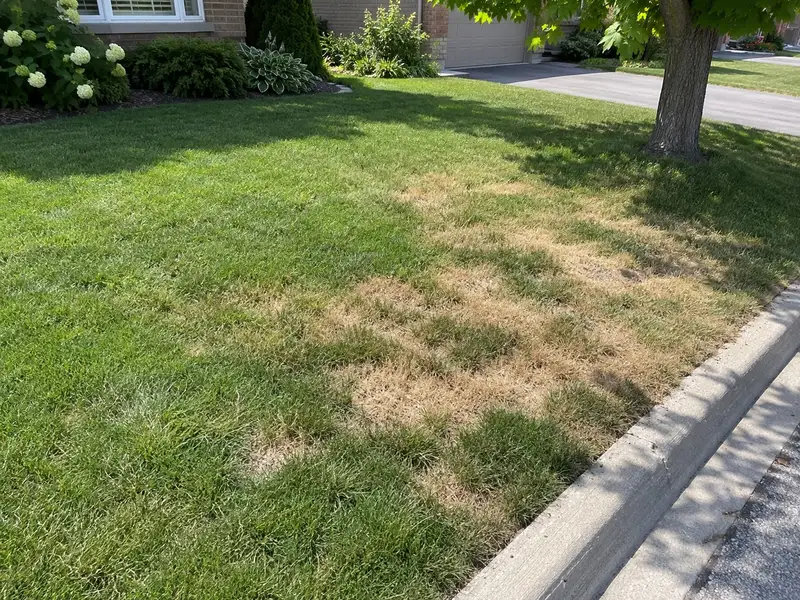
It often gets mistaken for drought, and it’s worst on lawns with heavy thatch that don’t get watered.
European chafer beetles fly from late June to mid-July, and their grubs do most of their damage feeding on roots in early fall. Damaged turf lifts like a carpet. Skunks and birds digging up the lawn are often the first sign.
Ontario’s cosmetic pesticide ban limits homeowners to products whose active ingredients are on the province’s Allowable List, which is mostly biopesticides and lower-risk products. TRCA suggests beneficial nematodes for grubs.
OMAFRA’s cultural controls for grubs are habits already in this calendar: deep watering, aeration, balanced feeding and a higher cut. For chinch bugs, Landscape Ontario suggests overseeding with a perennial ryegrass mix, which the bugs tend to avoid.
Common mistakes on GTA lawns
- Cutting short to stretch the time between mowings. TRCA’s 7.5 cm height shades out weeds and keeps the soil cool and moist. Short grass dries out first when July turns hot.
- Taking off more than a third of the blade after a missed week or two. OMAFRA and Landscape Ontario both give this one-third rule, so a lawn kept at 7.5 cm should be cut before it passes about 11 cm.
- Feeding in July heat, which Health Canada specifically advises against.
- Light sprinkling every evening instead of one deep watering a week.
- Seeding in October. OMAFRA’s seeding windows end in late September, and the sod growers’ rule of 45 days before the first frost rules out most of October.
- Letting grass get away in June. Markham’s property standards cap grass at 15 cm.
- Leaving a thick mat of leaves on the lawn into November.
- Bagging clippings. TRCA says they can boost soil fertility by up to 30 per cent, and Markham’s curbside yard pickup doesn’t take them anyway.
When it makes sense to call someone
Most of this calendar is weekend-sized work if you have a sharp mower and an hour a week. Mowing is the part people struggle to keep up with.
Missed weeks do the most damage, because the catch-up cut always takes off too much. So that’s the job most worth handing off, and it’s what our lawn care service is for.
Bigger problems are a different job. If grubs, dogs, shade or a dry summer have killed whole sections, new sod gives you a full lawn right away instead of waiting on seed. See our sod installation and lawn repair service.
For the leaf and debris side of spring and fall, the spring cleanup checklist and fall cleanup guide walk through what to do, or we can handle it as a seasonal cleanup.
We work across Markham and nearby, including Richmond Hill and Stouffville. Call (437) 684-2535 or text us a couple of photos of your lawn and we’ll come by for a free quote.
Other questions people ask
What is the recommended lawn fertilizing schedule in Ontario?
Plan on two or three feedings a year. Landscape Ontario suggests late May or early June, then a late fall feeding once top growth has stopped. OMAFRA's turf manual favours a high-nitrogen feeding between mid-August and mid-September, at no more than 0.5 kg of nitrogen per 100 m² each time. Health Canada says to use a lower rate in spring than in fall and to skip hot, dry weather, usually mid-June to early August.
What is the 1/3 rule of mowing?
Never cut off more than a third of the grass blade in one mowing. OMAFRA's turf manual and Landscape Ontario both give this rule. If you keep the lawn at 7.5 cm, cut it before it passes about 11 cm. Taking more off at once stresses the grass, scalps it and thins it out, which gives weeds room.
What's the worst time to mow the lawn?
The hottest part of the day, and when the grass is wet. The Professional Lawn Care Association of Ontario advises against cutting in midday heat and says a clean cut is easier on a dry lawn than a wet one. Wet clippings also clump and clog the mower. Pick a dry day and mow once the heat has eased.
What month do you stop mowing in Ontario?
There is no fixed month. OMAFRA's advice is to keep mowing until the grass stops growing, which in the GTA means some time in late fall. The Nursery Sod Growers Association of Ontario recommends a last cut before the first snowfall, about 30 per cent shorter than your usual height, which helps reduce matting under the snow.
Can you overseed a lawn in spring in Ontario?
Yes, but fall is better. OMAFRA lists mid-April to early June as a workable seeding window, with mid-August to mid-September preferred because soil moisture and temperature suit germination and fewer weeds sprout to compete. Spring seed has to get established before the July heat, so it needs steady watering.
Sources
- OMAFRA: Integrated Pest Management for Turf, Publication 845
- Toronto and Region Conservation Authority: Lawn care
- Health Canada: Maintaining a lawn
- Landscape Ontario: How to maintain a healthy lawn
- Nursery Sod Growers Association of Ontario: Prepare your lawn for winter
- Professional Lawn Care Association of Ontario: Lawn care tips
- City of Markham: Water use by-law
- City of Markham: Yard material collection
- City of Markham: Property standards
- Government of Ontario: Pesticides for home lawns and gardens
Related guides and service
- Fall lawn care in Ontario: overseeding, aeration and repair In Ontario, fall lawn work runs from late August into November. Overseed thin areas from mid-August to mid-September, with early September the sweet spot, ideally right after core aerating damp soil.
- How to get rid of creeping Charlie, crabgrass, clover and dandelions under Ontario's pesticide ban Ontario's cosmetic pesticide ban means the 2,4-D and triclopyr sprays in American lawn advice can't go on a home lawn here.
- Lawn grubs in Ontario: signs, skunk and raccoon damage, and what you can legally use Most lawn grubs in Ontario are European chafer larvae. They eat grass roots from late September into November and again in spring, so dead turf lifts like a carpet and skunks and raccoons dig it up.
- How much does lawn mowing and lawn care cost in Markham and the GTA? HomeStars' lawn care pages put a standard cut in Markham and Toronto at about $40 to $80 a visit, and bundled lawn care at $120 to $300 a month.