How to apply polymeric sand (and the mistakes that ruin it)
Short answer
To apply polymeric sand on Ontario interlock, clear the joints at least 1.5 inches (4 cm) deep, wait until the pavers are fully dry, sweep the sand in, compact it with a plate compactor, leave it 1/8 inch (3 mm) below the paver tops, blow the surface clean, then shower it in sections. In the GTA, plan for a dry day with no rain for 24 hours and temperatures above 0°C for 48.
Key numbers
- Joint depth to clear
- At least 1.5 in (4 cm)
- Finished sand level
- At least 1/8 in (3 mm) below the top
- Dry weather after install
- No rain for 24 hours
- Temperature
- Above 0°C for 48 hours
- Before pressure washing or sealing
- Wait 30 days
In this guide
Learning how to apply polymeric sand takes ten minutes. The hard part is the prep. Joints that are deep enough, pavers that are bone dry and a surface with no dust left on it decide whether the sand holds for years or cracks and leaves a white film on your interlock.
This guide assumes your pavers sit on a sand bed over a compacted gravel base, which is how most interlock driveways, walkways and patios in Markham and the rest of the GTA are built. If you want to know what polymeric sand is and how long it lasts, start with our polymeric sand guide. The numbered steps are further down the page.
What do you need before you start?
You need five things for any job:
- The polymeric sand
- A stiff push broom
- A leaf blower
- A garden hose with a shower nozzle
- A plate compactor
Old joints also call for a pressure washer and something to scrape out packed dirt. Tool rental shops carry compactors and pressure washers if you don’t own them.
Buy sand that suits the joints you actually have. Techniseal RG+ is rated for joints from 1/16 inch to 1/2 inch wide, and Alliance Gator’s Maxx G2 from 1/8 inch up to 4 inches.
For coverage, Techniseal lists 60 to 120 sq ft per 50 lb bag of RG+, depending on paver size and how wide and deep the joints are. Buy one bag more than you think you need. Running out halfway through is worse than returning a spare.
Read the label’s limits too. Techniseal says RG+ works for new installs and renovation work, but it points wide joints, steep slopes, pool decks and very humid spots to its HP NextGel sand instead.
When can you apply polymeric sand in Ontario?
Apply it on a dry day after a dry night, with no rain forecast for 24 hours and temperatures that stay above 0°C for the next two days. Around the GTA that usually means spring through early fall.
Late fall is risky because the sand has to stay above freezing while it dries. Alliance Gator says sand installed in the cold may never set properly.
The bigger problem in Ontario is moisture you can’t see. Pavers stay damp the morning after rain, after heavy dew on a humid July day, and on shaded walkways that never dry out fully.
Watch out
Don’t sweep sand onto pavers that are even slightly damp. Alliance Gator names damp pavers and high humidity as causes of white haze, because the sand starts setting on the surface instead of in the joints. Wait for the afternoon sun to dry everything, or give it another day.
The two big manufacturers publish these numbers:
Scroll sideways to see the whole table.
| What | Techniseal RG+ | Alliance Gator Maxx G2 |
|---|---|---|
| Temperature | Above 0°C for the 48 hours after installing | Above 0°C (32°F), in dry conditions |
| Rain after install | Handles surprise rain after 60 minutes; plan for 24 dry hours | Rain safe 15 minutes after wetting on a normal sand-set base |
| Joint width | 1/16 to 1/2 in (1.6 to 13 mm) | 1/8 to 4 in (3 mm to 10 cm) |
| Minimum joint depth | 4 cm (1.5 in) | 38 mm (1.5 in) |
| Fill level | Bottom of the chamfer, or at least 3 mm (1/8 in) below the top | At least 3 mm (1/8 in) below the top or the chamfer |
| Watering | Shower setting, about 200 sq ft at a time, two passes of roughly 30 seconds | Shower setting, at least 30 seconds per 30 sq ft, starting at the low point, one watering |
| Vehicles | 48 to 72 hours | 24 hours, once dry (Alliance Gator FAQ) |
Products change, so treat the bag in your hands as the final word.
How deep do the joints need to be?
At least 1.5 inches (about 4 cm). Both Techniseal and Alliance Gator set that as the minimum, and Alliance Gator says old sand should come out to at least that depth before new sand goes in.
It also warns that putting its sand over regular sand in a half-filled joint makes the surface peel and flake off. Our guide on putting new polymeric sand over old goes through why a thin top-up fails.
On an older driveway, getting to full depth is the slow part. Packed joints full of roots and dirt need a pressure washer and some patience. Alliance Gator says to take the old material out without disturbing the bedding sand under the pavers.
After washing, the pavers and the bedding underneath are soaked. They dry faster on a warm, breezy day and much slower in a cool, damp spring or fall. Techniseal notes that the bedding has to drain properly for the sand to dry, so don’t rush this part.
Why does compaction matter so much?
Because sweeping alone leaves gaps. Sand that has only been swept in looks full, then settles once it gets wet, and you end up with low joints that crack. Techniseal’s data sheet calls mechanical compaction mandatory for its RG+ sand and says skipping it can compromise the joints.
Run the plate compactor over the whole area, sweep in more sand, and run it again. Alliance Gator suggests compacting in several directions so no air pockets are left.
Thick pavers may need extra passes, according to Techniseal, and its test is simple: a finger shouldn’t sink into the joint. On textured or tumbled pavers, put a rubber pad under the compactor so it doesn’t scuff the faces.
How do you water polymeric sand without washing it out?
Use a gentle shower spray, never a jet, and wet one section at a time from the bottom of the slope up. Techniseal works in sections of about 200 sq ft.
Shower the section for roughly 30 seconds, wait a few seconds and shower it again.
Good to know
Before you move on, push a small screwdriver into a joint. Techniseal wants the sand wet through at least 75% of its depth. If the tip comes out dry near the bottom, that section needs a little more water.
Too much water floods the surface, washes sand out of the joint corners and leaves streaks on the pavers. Techniseal adds that overwatering makes the sand take much longer to cure.
Too little leaves the bottom of the joint dry and loose. Some products are meant to be watered once and others in several passes, so follow the method on your bag.
What are the most common polymeric sand mistakes?
These are the problems the manufacturers’ instructions warn about most:
- Putting the sand down on pavers that aren’t fully dry. Alliance Gator lists damp pavers as a cause of haze.
- Leaving dust on the surface before watering. Even a thin film sets and looks cloudy.
- Clearing old joints only half an inch or so deep and topping them up.
- Skipping the plate compactor, so the joints settle and crack.
- Filling the joints right to the top, where shoes and tires grind the edges off.
- Watering with a hard jet, or flooding the surface.
- Letting a section dry out partway through watering. Alliance Gator says the surface should stay wet until activation is done.
- Installing late in the fall, then getting a frost before the sand has dried.
- Pressure washing or sealing the pavers in the first 30 days. Techniseal says to wait.
- Re-sanding over pavers that are still sinking or rocking. The joints crack wherever the pavers move.
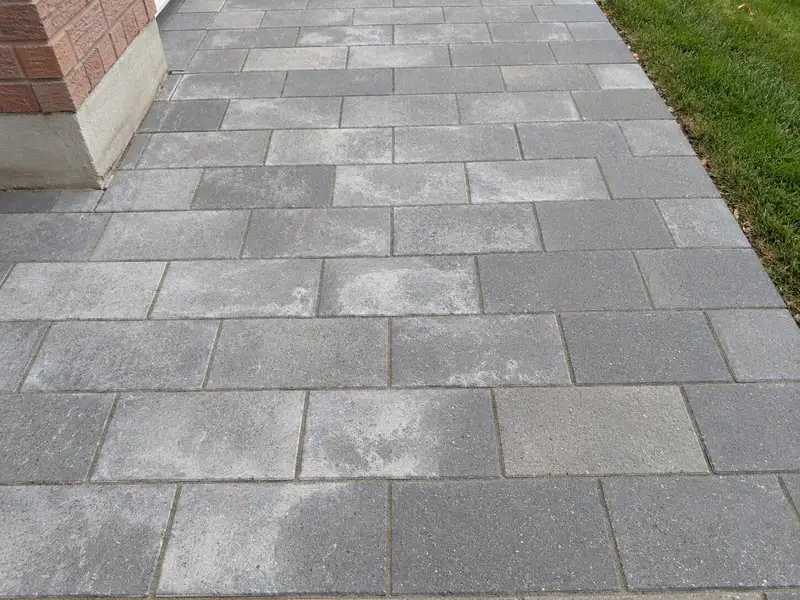
If haze does show up, our guide on removing polymeric sand haze explains how to get it off.
If weeds keep coming back after you re-sand, read how to stop weeds between pavers. Seeds can still sprout in the dirt that collects on top of the joints.
Should you do it yourself or hire someone?
A small patio or walkway in decent shape is a fair weekend job, as long as you’re patient about drying time and careful with the blower and the hose. It gets harder when the joints are packed solid, the area is large, or the pavers are textured and hold dust. That’s usually when people call in a crew for polymeric sand installation.
Sunken sections are a separate job. Those pavers need interlock repair to lift and relevel them before any sand goes in.
Clearing, relevelling and re-sanding is the work we do on our polymeric sand and weed removal jobs across Markham and nearby towns like Richmond Hill. If you’d like a second opinion on yours, call (437) 684-2535 or text us a photo.
Step by step
- Pick the right day. Choose a dry stretch with no rain forecast for 24 hours and temperatures that stay above 0°C for the 48 hours after you finish. Skip mornings after rain or heavy dew, and turn off any lawn sprinklers that reach the pavers.
- Clear the joints to full depth. Remove the old sand, weeds and dirt to at least 1.5 inches (4 cm). A pressure washer is the usual tool on old joints. Then let the pavers and joints dry out completely before going further.
- Fix loose or sunken pavers first. Lift and relevel any pavers that rock, have sunk or sit higher than their neighbours. New joints over a moving section will crack along with it.
- Spread and sweep the sand in. Pour the sand over a small area at a time and sweep it into the joints with a stiff push broom. Techniseal's instructions say to move it only short distances rather than pushing it across the whole surface.
- Compact, then fill again. Run a plate compactor over the whole area, with a rubber pad underneath to protect the paver faces. Sweep in more sand and compact a second time. Techniseal's check: a finger shouldn't sink into a properly packed joint.
- Leave the joints slightly low. Sweep off the excess so the sand finishes at the bottom of the paver chamfer, or at least 1/8 inch (3 mm) below the top edge. Techniseal warns that joints that aren't recessed can break down early.
- Blow every grain off the surface. Use a leaf blower held well back so it doesn't empty the joints. Any dust left on the pavers will set when it gets wet and leave a white haze.
- Shower it one section at a time. Set the hose nozzle to shower, start at the low end of the slope, and wet about 200 sq ft at a time. Techniseal RG+ gets two waterings of roughly 30 seconds per section. Alliance Gator's Maxx G2 takes a single watering.
- Check the depth, then move on. When water starts sitting on the joints, let it soak in and push a small screwdriver into a joint. Techniseal wants the sand wet through at least 75% of its depth. Finish each section before starting the next.
- Let it dry before you use it. Keep cars off for as long as the bag says: 48 to 72 hours for Techniseal RG+, or 24 hours once dry for Alliance Gator's sands. Cool, damp weather stretches that. Techniseal also says to wait 30 days before pressure washing or sealing.
Other questions people ask
How do you install polymeric sand between bricks?
The same way as on concrete pavers, as long as the bricks are laid on a sand bed and not mortared onto concrete. Techniseal says its sand is only for pavers set on a drainage bed. Clay brick needs extra care with drying: Alliance Gator warns that clay pavers are more porous and can still be damp when they look dry, which leads to haze.
Can I fill cracks in concrete with polymeric sand?
It isn't made for that. Polymeric sand needs a joint at least 1.5 inches deep with a sand bed underneath that drains, and a crack in a poured slab offers neither. Techniseal's data sheet limits its sand to pavers set over a drainage base and bedding sand. A crack in a concrete slab calls for a concrete crack filler or a flexible joint sealant instead.
What happens if you use too much water on polymeric sand?
Unilock says to mist in light passes rather than flooding, because a flood can wash out the joint corners and leave sand streaks on the pavers. Techniseal adds that overwatering its RG+ sand makes it take much longer to cure and can weaken it, and tells installers to avoid run-off and foaming. Too little water is a problem too, since the lower part of the joint won't set.
Do you need a plate compactor for polymeric sand?
For joints that last, yes. Techniseal's data sheet calls mechanical compaction mandatory for its RG+ sand and says skipping it can compromise the joints. Sweeping alone leaves air pockets, so the sand settles later and the joint drops and cracks. Plate compactors can be rented by the day, and a rubber pad under it protects textured paver faces.
Sources
Related guides and service
- Polymeric sand: what it is, when to replace it, and what affects the cost Polymeric sand is joint sand mixed with a binder that hardens as it dries, locking interlock pavers together and resisting weeds, ants and washout.
- Can you put new polymeric sand over old? Not as a thin top-up. A skim of new polymeric sand over old, hardened joints tends to crack and flake, and Alliance Gator advises treating the job as a new install.
- How to remove polymeric sand haze from pavers Polymeric sand haze is sand dust and binder that set on the face of the pavers.
- How to stop weeds growing between pavers Weeds grow between pavers when the joint sand washes out or dirt settles on top of it.