Interlock restoration: pressure washing and new polymeric sand
Short answer
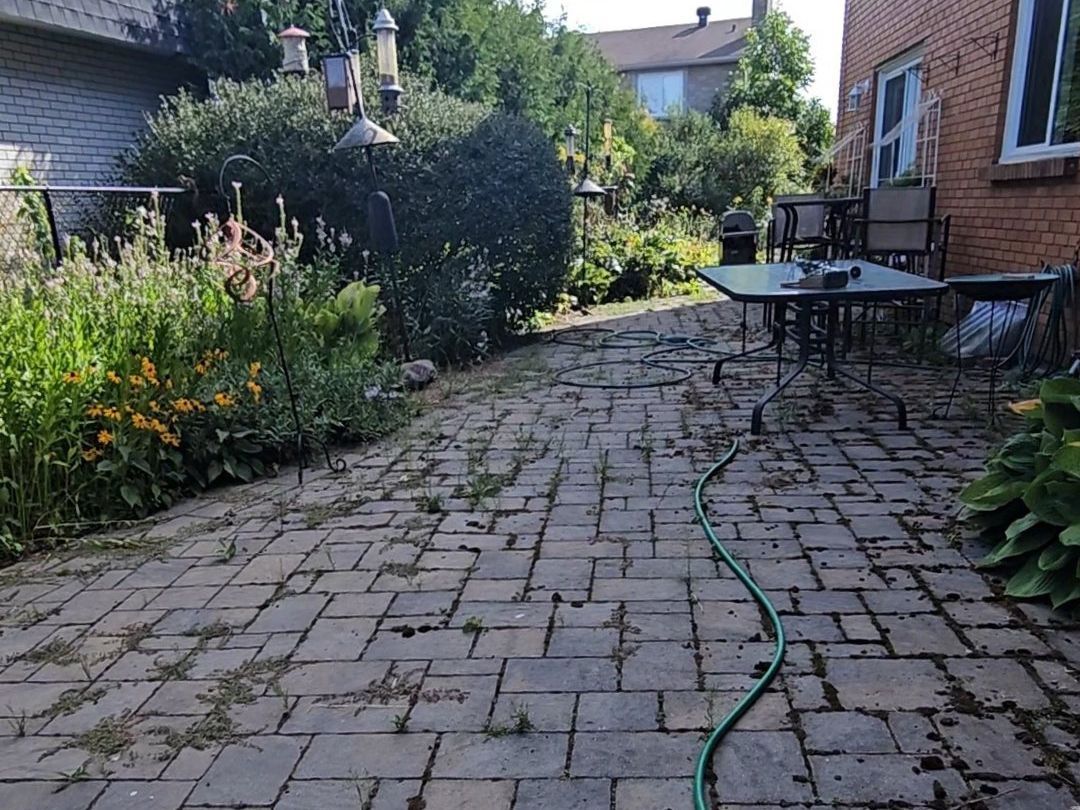
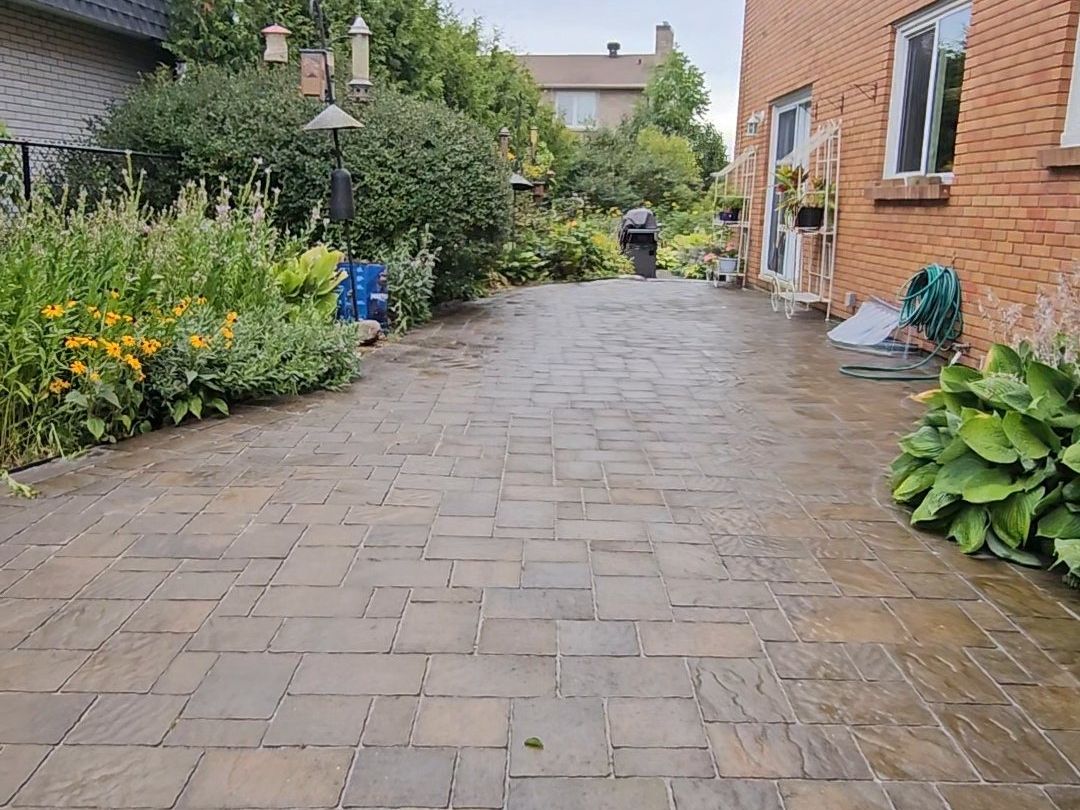
This interlock restoration was a cleaning and re-sanding job, not a rebuild. A long side-yard patio had weeds and grass in many joints and grime across the pavers, but the stones were still flat. We pressure washed it, cleared out the old joint material and swept in new polymeric sand. Nothing was lifted, and the tan, brown and grey colours show again. We do this work across Markham and nearby.
What we did
- Pressure washing
- New polymeric sand
Interlock restoration on a patio like this is mostly about the joints: clean the surface, then put new polymeric sand back into every one.
What did the patio look like before and after?
Before, it was a dull grey patio with weeds coming up through a lot of the joints. The photo looks down a long run of interlock beside a two-storey brick house, with a chain-link fence on the other side. The pavers are mixed-size rectangles in a random pattern.
Weeds are thickest along the garden bed on the left. Most other joints look dark and dirty rather than sandy, with clumps of debris on the stone. A patio table, chairs and a hose are still out.
The after photo is taken from almost the same spot. The furniture is gone, the weeds are out, and the pavers show their tans, browns and greys again. The joints are full of fresh, light grey sand.
The surface is still wet, which makes the colours look a little deeper than they will once it dries. The garden beds on both sides, with yellow black-eyed Susans on the left and hostas on the right, are still in place.
Why were weeds growing between the pavers?
Weeds got in because the joint sand had washed out over the years. Unilock says weeds don’t grow up from beneath the stones. Seedlings fall into the gaps the sand leaves behind.
Pulling them by hand leaves roots behind, and the open gap keeps catching dirt and seeds. The lasting fix is to clear the old material out to a proper depth and refill the joints. Our guide on stopping weeds between pavers covers the other options.
How do you restore interlock with polymeric sand?
You clean the pavers, clear out the old joints, let everything dry, then sweep in polymeric sand and wet it. A job like this goes in this order:
- Furniture, pots and hoses come off so the whole surface can be cleaned.
- Pressure washing takes the grime off the paver faces and blasts the old joint material and weed roots out of the joints.
- Everything dries out. Techniseal warns that on a damp surface the binder activates early, so the sand sticks to the paver faces instead of flowing down into the joints.
- The new sand is swept into every joint, settled with a plate compactor and topped up until the joints stay full.
- Loose sand is blown off the paver faces, then the joints are wetted with a hose on the shower setting.
That last watering is probably why the after photo shows a wet surface. The manufacturers’ numbers for this kind of job:
Scroll sideways to see the whole table.
| Step | What the manufacturer says | Source |
|---|---|---|
| Clearing old joints | At least 1.5 in (38 mm) deep | Alliance Gator |
| Finished sand level | About 1/8 in (3 mm) below the paver top | Alliance Gator, Techniseal |
| Watering check | Joints wet about 1.5 in (4 cm) down, checked with a small screwdriver | Techniseal |
| Rain | Holds up to unexpected rain 60 minutes after install, but plan on 24 hours dry | Techniseal |
| Temperature | Stays above 0°C for the 48-hour drying period | Techniseal |
The full method is in our guide on how to apply polymeric sand.
Why weren’t the pavers lifted and relaid?
The pavers were still level, so lifting them would have added cost without fixing anything. Cleaning and re-sanding fixed the joints and left the patio as it was laid.
If parts of it had sunk, those areas would have needed interlock repair first. Alliance Gator is blunt about this: polymeric sand doesn’t crack on its own, and any cracking comes from pavers moving.
Why use polymeric sand instead of regular joint sand?
Polymeric sand has a binder that sets firm once it’s wetted, and plain joint sand has none. That’s why plain sand washes out of joints like these in the first place.
Techniseal says its sand starts to set a few minutes after wetting, soon holds up to rain and sprinklers, and inhibits weed growth once it’s dry. Our polymeric sand guide explains how long it lasts and the signs it needs replacing.
How do you keep restored interlock clean?
Mostly by sweeping it and not letting weeds or leaves settle into the joints. These habits help:
- Sweep or blow it off regularly. Unilock’s spring maintenance advice says weed seeds often drift in from neighbouring yards, and regular sweeping stops new seedlings from taking root.
- Don’t let leaves sit. Unilock lists tannins from trees among the organic stains pavers pick up.
- If a weed does appear, pull it while it’s small.
- Go easy with the pressure washer. Unilock’s spring advice is a low setting and a fan tip, held at knee height and angled at 45 degrees so the spray doesn’t dig sand out of the joints. Our guide to cleaning interlock without damaging it has more on this.
- Some people seal their interlock after re-sanding. Unilock says to give the polymeric sand the full cure time the manufacturer lists first. Our interlock cleaning and sealing page explains the options.
If your patio, walkway or driveway looks like the before photo, text us a picture at (437) 684-2535 or use the form below for a free quote. We do polymeric sand installation and interlock cleaning across Markham and nearby.
What customers say
5.0 on Google · 7 reviews. Read all reviews on Google
Great experience! These guys did an amazing job bringing life back to my property. They removed all the weeds, treated the area, put mulch, and cleaned the interlock. The transformation was incredible! Very happy with the quality of work, professionalism, and the price. Highly recommend!
Read moreShow less
Ivanna B. · Google · August 2026 Great service, best team for gardening and pressure washing. Happy with the results! Next time will invite them in few months for window cleaning
Yaroslav · Google · August 2026 Worked w the owner, this was for yard cleanup, he had a professional crew and they got the job done fairly quickly in the front and backyard.
Jack K. · Google · October 2026
Want something like this done?
Tell us what needs doing and where. We’ll get back to you to book a visit, look at the job in person and give you a price. Quotes are free.
Call or text (437) 684-2535.
Faster: text 2–3 photos of the area to the same number.
Thanks, we've got your request.
We'll be in touch to arrange a visit.
If you have photos of the area, text them to (437) 684-2535 and we'll take a look before we come out.