How to clean interlock without damaging it
Short answer
To clean interlock in Ontario, sweep it, pull the weeds, treat stains with a cleaner made for concrete pavers, then scrub with soap and water. Rinse at about 1,500 PSI with a wide fan tip, angled, never a red 0° tip. Washing pulls sand out of the joints, so refill them with polymeric sand on a dry day that stays above 0°C for the next 48 hours. In the GTA, spring after the salt season is a good time.
Key numbers
- Rinse pressure
- About 1,500 PSI
- Wand distance (no pressure dial)
- At least 24 inches
- Spray angle
- 45 degrees, wand at knee height
- Vinegar on moss and mildew
- 10–15 minutes, then rinse
- Weather for new joint sand
- 24 hours dry, above 0°C for 48 hours
In this guide
Interlock cleaning needs less gear than most people expect: a broom, dish soap, a nylon brush and a pressure washer turned down to about 1,500 PSI. The damage usually comes from shortcuts. A narrow tip held close to the stone does it, and so does acid poured on to save scrubbing, or joints left empty after the wash.
This guide is for concrete interlock pavers laid on a sand bed. Natural stone, clay brick and wet-cast pavers can react differently to some cleaners (Techniseal’s rust remover, for one, isn’t meant for any of them), so check the label for your material.
If you’d rather hand the whole job over, that’s what our interlock cleaning service covers. The numbered steps are further down the page.
What do you need for interlock cleaning?
For a light clean you need very little:
- A push broom and a nylon scrub brush
- A bucket of dish soap and water
- A garden hose
- A plastic scraper for anything stuck on
For a full clean, add a pressure washer with a wide fan tip (or a surface cleaner attachment), a leaf blower, rubber gloves and safety glasses. You’ll also want enough polymeric sand to refill the joints afterwards.
Watch out
Leave the wire brush in the garage. Unilock warns that wire bristles can damage the surface and leave metal bits behind, which can turn into rust stains.
How much pressure is safe for pavers?
About 1,500 PSI, which is less than most machines can give. That figure comes from Western Interlock, a paver manufacturer in Oregon. If your washer isn’t adjustable, it says to hold the wand at least 24 inches from the surface and use the widest tip you have.
Unilock’s spring maintenance advice is similar: a low setting with a fan tip, the wand at about knee height, and the spray angled at 45 degrees so it doesn’t dig the sand out of the joints.
Keep the wand moving at an even speed and the same distance from the stone. Western Interlock notes that moving too fast leaves small swirl marks. Unilock warns that the wrong pressure or nozzle can crack or erode the paver surface.
Good to know
Try a few pavers in a corner first. On a big driveway, a surface cleaner (the round attachment with spinning jets under a hood) gives the most even result.
The tip matters as much as the pressure. Here’s how Alkota, a pressure washer maker, describes the standard tips, and what that means on pavers:
Scroll sideways to see the whole table.
| Tip colour | Spray angle | Alkota’s intended use | On interlock |
|---|---|---|---|
| Red | 0° | Debris, grout, expansion joints | Don’t use it. Alkota warns surface damage happens quickly. |
| Yellow | 15° | Stripping paint, grease and gum | Too concentrated for washing a whole surface. |
| Green | 25° | Decks, fences, siding, vehicles | Workable on pavers if held well back. Test a corner first. |
| White | 40° | Sweeping large areas, rinsing | The safest place to start. |
| Black | 65° | Applying soap, about 500 PSI | For putting cleaner down, not for rinsing. |
| Turbo or rotary | Spinning 0° jet | Heavily stained concrete | Alkota warns it can damage surfaces quickly. Not worth the risk on coloured pavers. |
Which cleaner works on which stain?
Treat the stains first, then clean the whole surface. Otherwise you end up with a patchy finish.
Use products labelled for concrete pavers, and test each one on a small hidden spot before you do the whole area.
Scroll sideways to see the whole table.
| Stain | Start with | If it’s still there | Source |
|---|---|---|---|
| General dirt, grime, algae | Soap and water, soft-bristled brush, low-pressure rinse | A paver cleaner | Unilock |
| Moss and mildew | White vinegar left 10–15 minutes, then rinsed | An organic stain remover, left 5–10 minutes, then scrubbed | Unilock, Techniseal |
| Dead leaves, wine, food | Blot, then soap and water | An organic stain remover | Unilock, Techniseal |
| Oil drips on the driveway | Soak it up with paper towels or kitty litter, then soap and water | An oil remover that dries to a powder and lifts the stain | Unilock, Techniseal |
| Rust (fertilizer, metal furniture, plough blades) | A paver rust remover with no muriatic acid, scrubbed with a nylon brush and rinsed right away | A second application | Techniseal |
| White powder (efflorescence) | Dish soap and a stiff plastic brush | An efflorescence cleaner, tested first | Unilock |
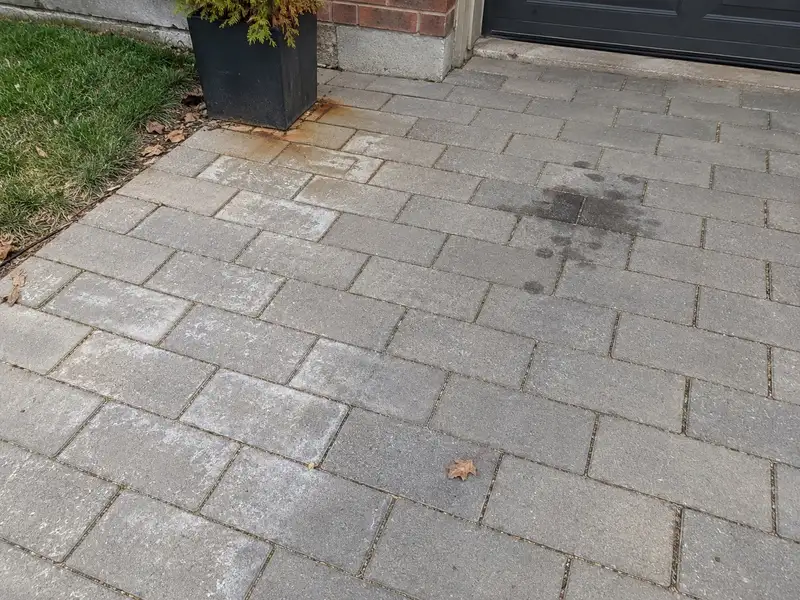
Rust remover can leave its own mark. Techniseal says pavers can look spotted afterwards (it calls this a “clean stain”) and suggests cleaning the whole surface for an even result. It also warns that rust streaks from metal snowplough blades may never fully come out.
White powder is a different story. Unilock notes that efflorescence removers are usually acid-based and can shift the colour slightly. Efflorescence is also usually temporary and fades on its own, so on newer pavers it can pay to wait.
If the white film appeared after new joint sand went in, it may be polymeric sand haze instead, which needs a different fix. Our guide on removing polymeric sand haze explains how to tell them apart.
Why does washing take the sand out of the joints?
Because water under pressure moves loose sand, especially when it’s aimed into the joints. Unilock warns that the wrong pressure or nozzle can blow joint sand out, and the last step in its cleaning routine is to check the joints and sweep in new joint material.
On an older driveway the joints are often half empty or full of weeds anyway. So a full clean usually ends with new polymeric sand.
That step has its own rules:
- The joints must be dry to the bottom, not just the paver faces.
- The surface has to be blown spotless before any water touches it.
- The weather has to cooperate. Techniseal’s instructions for its RG+ sand say to plan for 24 hours without rain and to keep temperatures above 0°C through a drying period of at least 48 hours.
Check the bag you buy, too. Techniseal recommends its HP2 formula rather than RG+ for joint replacement on an existing installation. Our polymeric sand guide covers how deep to clear the joints and how much sand you’ll need.
When is the best time to clean interlock in Ontario?
Any time from spring to early fall works, ideally on a mild, overcast, calm day.
Spring makes sense in the GTA. Melting snow, ice and spring rain wash salt, grit and dirt onto the pavers, and the joints can need attention after a winter of freeze and thaw.
A few Ontario-specific points:
- Leave yourself room for the re-sanding step. If frost is likely in the next two days, wait, because the new joint sand needs temperatures above 0°C for at least 48 hours while it dries.
- Avoid the hottest part of a summer day. Techniseal says not to apply its stain remover under blazing sun and never to let it dry on the surface.
- Early fall is a good second window, as long as the nights are still above freezing. Freshly set joints go into winter full, with less room for water and weeds.
- In winter, go easy on de-icers. Unilock says rock salt can be used on driveways, but sparingly, and that magnesium-based products should be avoided. Rock salt stops working below about -9°C anyway.
- Unilock suggests a plastic shovel too, because metal blades can scratch pavers and leave tiny metal bits that turn into rust streaks.
Mistakes that damage interlock
Most cleaning damage comes down to one of these:
- Using a red 0° tip or a turbo nozzle up close. It can erode the face of the paver, and you can’t wash that out.
- Spraying straight down into the joints, which blows the sand out of them.
- Scrubbing with a wire brush, which can leave rust spots behind.
- Reaching for muriatic acid or mixing products to make them stronger. Techniseal points out that its paver rust remover contains no muriatic acid so it won’t damage the material, and says not to mix its cleaners with other chemicals.
- Letting a cleaner dry on hot pavers before rinsing.
- Sealing a surface that isn’t fully clean. Techniseal’s guidance is that sealing dirty pavers never gives the intended result, and efflorescence sealed in stays trapped under the film.
- Walking away with the joints empty. Open joints collect dirt and weed seeds, and pavers with nothing between them to hold them tight can start to shift.
If you’re thinking about sealing after the clean, read our interlock sealing guide first. It’s optional, and timing matters more than the product.
When is it worth calling someone?
A small patio or a single walkway is a fair weekend job if you’re patient and test before you spray.
It’s worth getting help when:
- the area is a large driveway
- moss and weeds are in nearly every joint
- stains haven’t moved after a proper try
- you’d rather not rent equipment and handle the polymeric sand step yourself
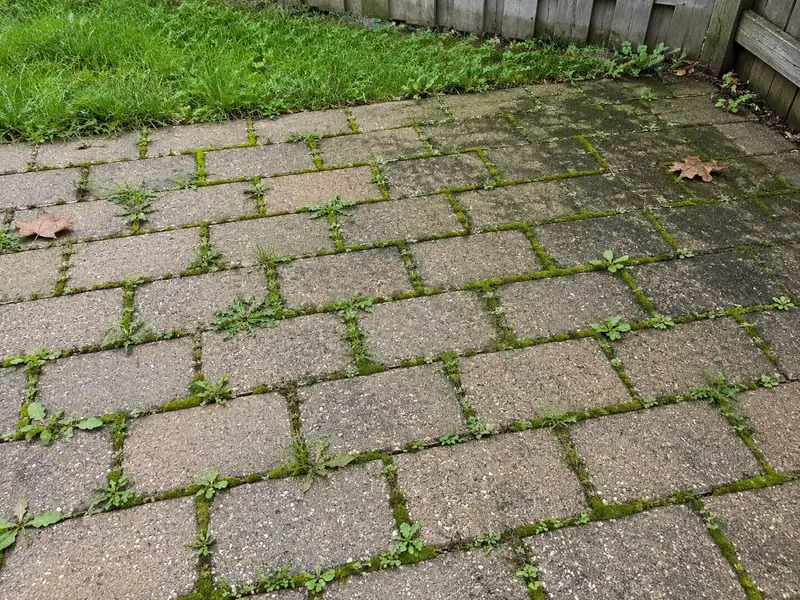
If some pavers have sunk or rock underfoot, cleaning won’t fix that. Those sections need lifting and relaying first.
We do interlock cleaning and pressure washing across Markham and nearby towns like Richmond Hill and Stouffville, along with weed removal and joint-sand replacement. Call (437) 684-2535 or text us a photo of the area, and we’ll come and look and give you a free quote.
Decks and fences need gentler settings again. Our guide on pressure washing decks, fences and interlock covers those.
Step by step
- Clear the surface and look it over. Move planters and furniture, then sweep or blow off loose dirt and leaves. Check for pavers that have sunk, cracked or rock underfoot. Cleaning won't fix those, so plan the repair first.
- Pull weeds and moss out of the joints. Use a weeding tool or plastic scraper to get weeds, grass and moss out of the joints and along the edges, roots included where you can.
- Treat the stains before the general wash. Spot-treat oil, rust and leaf stains with a cleaner made for that stain on concrete pavers. Test each product on a small hidden spot first and never mix cleaners.
- Scrub the whole surface. Wet nearby plants and lawn first. Scrub the pavers with dish soap and water or a paver cleaner, using a nylon scrub brush or a soft-bristled push broom, never wire. Keep any cleaner wet until it's rinsed off.
- Rinse at low pressure. Rinse with a wide fan tip or a surface cleaner at around 1,500 PSI, holding the wand at an angle rather than straight down. Move at a steady pace and send the water toward a suitable drainage point. Check local rules before rinsing cleaners into a street drain.
- Let the pavers and joints dry out. Wait for a dry stretch until the joints are dry to the bottom, not just the paver faces. On a damp surface the polymer can activate early, so sand sticks to the pavers and stains them.
- Refill the joints. Sweep polymeric sand into the joints, compact it, blow every grain off the surface and mist it with water. Pick a day with no rain expected for 24 hours and temperatures that stay above 0°C for 48.
- Decide whether to seal. Sealing is optional. If you want it, the surface has to be clean, dry and free of white efflorescence first, and Unilock asks for 24 to 48 hours of dry weather.
Other questions people ask
Does white vinegar clean interlock?
For mould and mildew spots, yes. Unilock suggests pouring white distilled vinegar straight onto the spots, leaving it for 10 to 15 minutes and rinsing with water. It's meant for mould, mildew and moss, not for oil or rust, and vinegar is an acid, so test it on a hidden paver first and rinse well. For general dirt, soap and water is the gentler start.
How do you clean pavers without a pressure washer?
Use soap and water or a mild detergent, scrub with a soft-bristled broom or nylon brush, and rinse with a garden hose. That's Unilock's own spring advice for most dirt and spills, with a plastic scraper for leftover moss or algae. It takes more elbow grease, but there's far less risk of eroding the paver faces or blowing out the joint sand.
What is the best cleaner for interlock?
There isn't one cleaner for everything. Match the product to the stain: a degreaser or oil remover for driveway drips, a rust remover for orange marks, an organic stain remover for moss and leaf stains, and an efflorescence cleaner for white powder. Use products labelled for concrete pavers, and test each one on a small hidden area first.
How do you make old interlock look new again?
Most of the difference comes from cleaning the faces and redoing the joints: wash off the grime, pull the weeds, and refill the joints with fresh polymeric sand so the pattern looks sharp again. A wet-look sealer can deepen faded colour, but only on a clean, fully dry surface. Pavers that have sunk or cracked need to be lifted and relaid.
Sources
- Unilock: Paver cleaning
- Unilock: Spring paver maintenance tips
- Unilock: Winter paver maintenance
- Unilock: Efflorescence 101, what it is and how to remove it
- Western Interlock: Best practices for pressure washing pavers
- Alkota: What do different nozzles for pressure washers do?
- Techniseal: Organic Stain Remover for pavers technical data sheet
- Techniseal: Rust Remover for pavers technical data sheet
- Techniseal: Pro-Grade Oil & Grease Remover
- Techniseal: Paver care stain removers and cleaners brochure
- Techniseal: RG+ Polymeric Sand technical data sheet
Related guides and service
- Polymeric sand: what it is, when to replace it, and what affects the cost Polymeric sand is joint sand mixed with a binder that hardens as it dries, locking interlock pavers together and resisting weeds, ants and washout.
- How to remove polymeric sand haze from pavers Polymeric sand haze is sand dust and binder that set on the face of the pavers.
- Should you seal your interlock? When and how often in Ontario Interlock sealing is optional. Unilock says its pavers don't need it, but a sealer brings back colour, makes stains easier to clean and can harden joint sand.
- Pressure washing decks, fences and interlock without damage You can pressure wash a deck, fence or interlock in Ontario without damage if the pressure suits the surface.