How to stop weeds growing between pavers
Short answer
Weeds grow between pavers when the joint sand washes out or dirt settles on top of it. To stop them in Ontario, pull the weeds, clear the joints at least 1.5 inches (4 cm) deep, and refill with polymeric sand to at least 3 mm below the paver tops when it will stay above 0°C for 48 hours. Then sweep the surface often. Glyphosate weed killers are banned for cosmetic use on patios and driveways across Ontario.
Key numbers
- Joint depth to clear
- At least 1.5 in (4 cm)
- Finished sand level
- At least 3 mm (1/8 in) below the paver tops
- Temperature after install
- Above 0°C for 48 hours
- Dry weather after install
- No rain for 24 hours
- Wait before sealing
- 30 days (Techniseal RG+ and EZSAND)
In this guide
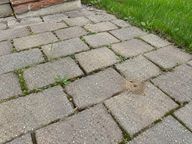
Weeds between pavers start with the joints. Seeds land in the gaps, and if the sand there has washed down or filled with dirt, they root. Stopping them means three things: clear the joints out deep, refill them with polymeric sand that sets firm, and keep the surface swept.
Pulling or spraying only buys you a few weeks. In Ontario you can’t use glyphosate on a patio or driveway, so the joint itself has to do the work.
If you’d rather hand it off, clearing weedy joints and re-sanding them is what our polymeric sand and weed removal service covers.
Why do weeds grow between pavers?
Weeds grow between pavers because the joints give seeds somewhere to sit and stay damp. Unilock says weeds come up when the jointing sand washes away and leaves room for seedlings, and the moist, dark gap suits germination.
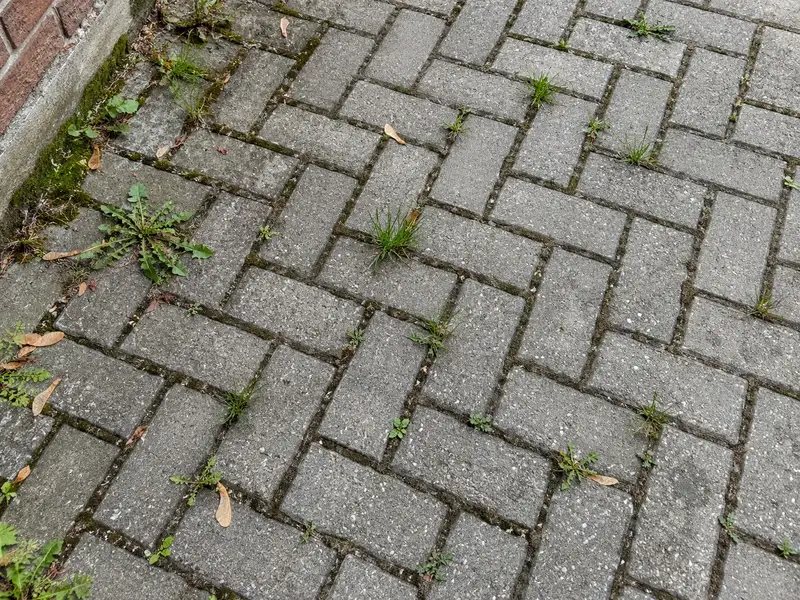
The usual causes are:
- Plain sand that has washed down over the years, leaving joints half empty.
- Polymeric sand that was never cleared deep enough, so it cracked and flaked out.
- Dirt, leaves and grass clippings that settle into the top of the joints and turn into a thin layer of soil.
- Shady, damp edges and spots under trees, where moss gets going first and weeds follow.
- Sunken or rocking pavers, where joints open up and water sits.
Techniseal lists shade, moisture and soil or grass clippings left on the joints as causes of moss and early joint breakdown.
Watch out
If parts of the surface have dropped, re-sanding alone won’t hold. The joints crack again as the pavers move. Our guide on why interlock sinks and how to fix it covers that part.
Is weed killer legal on interlock in Ontario?
Some weed killers are, but the common ones aren’t. Under Ontario’s Pesticides Act and Ontario Regulation 63/09, you can’t use certain pesticides to kill weeds on patios and driveways, or on lawns and gardens.
The province names glyphosate, 2,4-D and diazinon among the banned ingredients for cosmetic use.
You can use products made only from active ingredients on Ontario’s Allowable List (version 5, effective November 28, 2022). That list includes:
- acetic acid
- soaps of fatty acids
- iron in the form of FeHEDTA
- sodium chloride
- corn gluten meal
Acetic acid (vinegar) products only kill the parts of the plant they touch, so deep-rooted weeds can grow back. Read the label and follow it.
Which ways of killing weeds between pavers work?
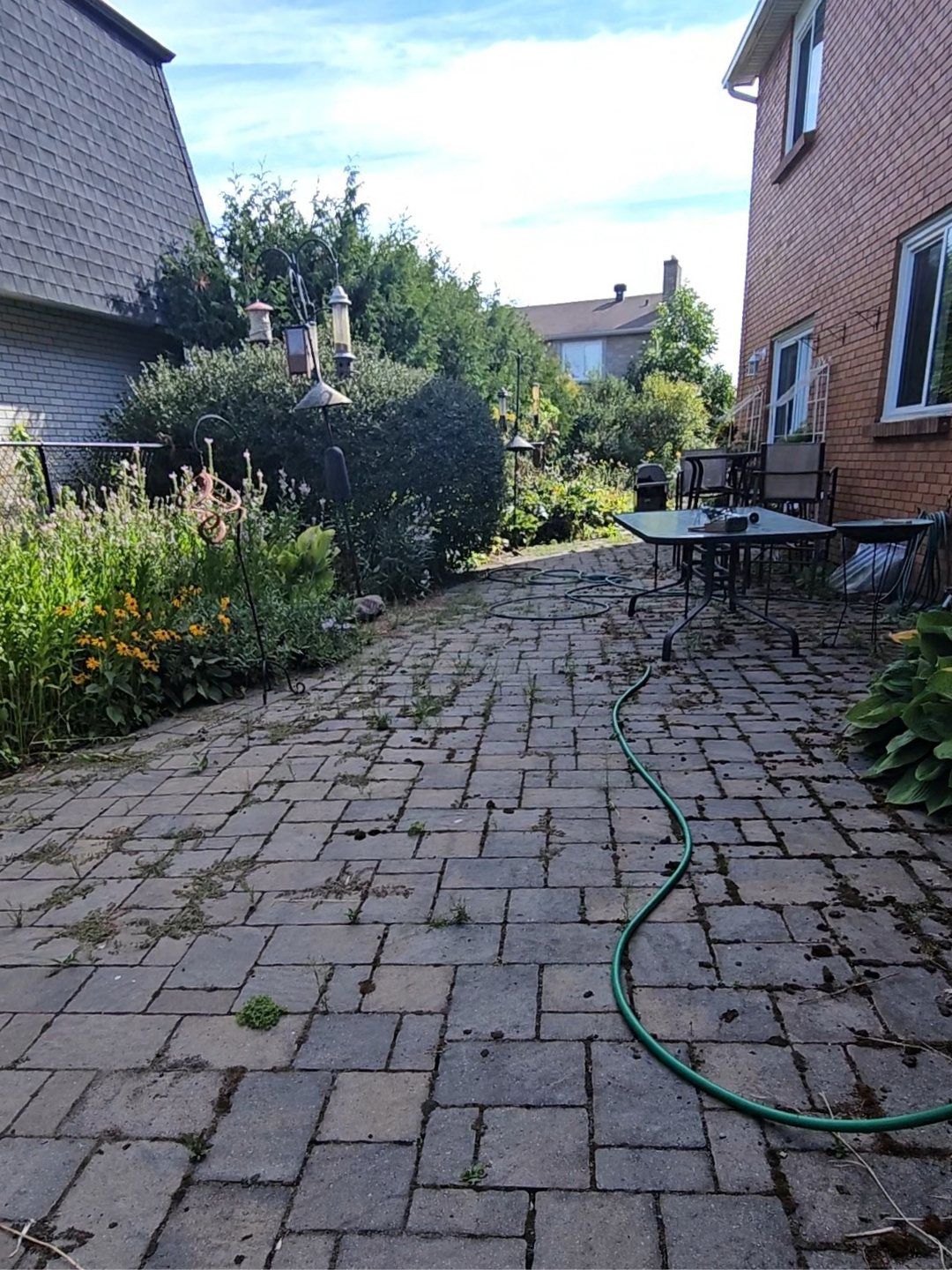
Pulling, scrubbing and spraying all deal with the weed you can see. Only the last row in the table fixes the joint, which is why weeds keep coming back after the quick fixes.
Scroll sideways to see the whole table.
| Method | What it does | How long it lasts | Source |
|---|---|---|---|
| Weeding knife or wire paving brush | Cuts or scrapes weeds out of the joint. Repeated removal weakens deep-rooted weeds. | Weeks, unless the joint is refilled | Royal Horticultural Society |
| Household vinegar (about 5% acetic acid) | Too weak to control most weeds | Little effect | University of Illinois Extension |
| Horticultural vinegar (10–20% acetic acid) | Burns top growth, best on young seedlings. Doesn’t move to the roots, so perennials regrow. Corrosive to skin and eyes. | Until the roots resprout or new seeds land | Oregon State and Illinois Extension |
| Salt | Kills what it touches, but dissolves and moves through soil into nearby lawn and beds | Short, with a risk to plants you want | University of Illinois Extension |
| Boiling water | Scalds what it touches | Short | Unilock |
| Glyphosate or 2,4-D products | Not allowed on Ontario patios and driveways for cosmetic use | Not an option | Government of Ontario |
| Clearing the joints and refilling with polymeric sand | Takes away the space and loose material seeds root in | Alliance Gator says about 15 years when installed to its instructions on pavers laid to industry standards | Alliance Gator, Techniseal |
So kill or pull what’s there first, then fix the joint. Do only the first half and you’ll be pulling the same weeds again next summer.
Does polymeric sand stop weeds for good?
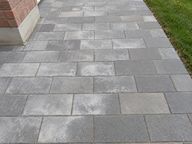
Polymeric sand stops most weeds, but not every one. Techniseal says its RG+ sand hardens after it dries, stays put where plain sand washes out, and prevents weed growth. A full, hard joint gives roots nowhere to go.
It can’t stop a seed landing in dirt that has built up on top of the joint. Alliance Gator says to clean the surface from time to time and not let dirt pile up on the joints, and Techniseal says the same about soil and grass clippings. Regular sweeping takes care of most of it.
The sand only works if it goes in properly:
- Clear the old sand out. Alliance Gator says to remove it at least 1.5 inches deep before refilling, and Techniseal lists a minimum joint depth of 4 cm (1.5 inches).
- Fill and compact until the sand sits at the bottom of the paver chamfer, or at least 3 mm (1/8 inch) below the paver tops. Techniseal warns that joints left full to the top can break down early.
- Blow the surface clean before any water goes on.
Our polymeric sand guide explains how the product works and how much you need, and how to apply polymeric sand goes through the mistakes that make it fail.
When should you re-sand pavers in Ontario?
Re-sand between late spring and early fall, on a stretch of dry days. Techniseal’s conditions are:
- the temperature stays above 0°C for 48 hours after installation
- the pavers and joints are dry
- no rain is forecast for the next 24 hours
Alliance Gator also says its sand should go down above 0°C.
In Markham and the rest of the GTA, late fall is a gamble with cold nights, and winter is out.
Good to know
The pavers have to be dry right through, so a sunny afternoon after a rainy night isn’t enough. Give it a full dry day or two before you sand.
Pulling and brushing has no season. Do it whenever weeds show up, ideally while they’re small and before they set seed.
If you’re cleaning the surface anyway, our guide on how to clean interlock without damaging it covers pressure settings and cleaners.
Why do weeds come back after re-sanding?
Weeds come back after re-sanding when the job took shortcuts. These are the common ones:
- Sweeping new sand over old, weedy joints. The roots are still there and the new layer has nothing solid to bond to.
- Clearing joints only an inch or less. Alliance Gator and Techniseal both want at least 1.5 inches (4 cm), and a shallow layer is more likely to crack and come loose.
- Blasting the joints with the pressure washer on high, held close to the surface. Unilock warns against both.
- Sanding pavers that are still damp. The sand sticks to the surface instead of running down into the joints, and can leave a haze.
- Leaving sand dust on the paver faces before wetting.
- Re-sanding over sunken or rocking pavers without fixing them first.
- Putting seeding weeds in the home compost. The RHS notes home compost may not get hot enough to kill the seeds.
Keeping the joints clean afterwards
After the sand has set, upkeep is mostly sweeping. Unilock recommends sweeping paving stones regularly so seedlings can’t settle in.
A leaf blower is faster, and it’s worth a pass after the leaves drop in the fall. Pull any weed that does show up while it’s small.
Good to know
Want to seal the pavers too? Wait until the sand has fully cured. Techniseal says to wait 30 days after installing its RG+ and EZSAND sands before cleaning and sealing, so check the bag for your product.
When it’s worth calling someone
A small patio with mostly sound joints is a reasonable weekend job if you have a dry forecast and patience for the drying step.
Get help when weeds cover most of a driveway, the old sand is packed hard, or some pavers have sunk. Those jobs take longer than people expect.
A rushed re-sand with shallow joints or no compaction is the kind that cracks and lets weeds back in.
If that sounds like your interlock, call or text us a photo at (437) 684-2535, or have a look at our polymeric sand and weed removal page.
If parts of the surface have dropped, we handle that as interlock repair before any new sand goes in. Quotes are free.
Step by step
- Pull the weeds you can see. Lift out the bigger weeds by hand or with a weeding knife run along the joint, getting as much root as you can. Bag anything that has gone to seed instead of composting it.
- Scrub out moss and seedlings. Go over the joints with a stiff wire paving brush to break up moss, small seedlings and the dirt they are growing in.
- Clear the old joint sand. Wash the old sand and roots out of the joints to at least 1.5 inches (4 cm) deep. Keep the pressure washer on a moderate setting and well back from the paver surface.
- Let everything dry completely. Wait until the pavers and the joints are completely dry, right to the bottom. Damp pavers make the new sand stick to the surface. Drying takes longer in cool or humid weather.
- Sweep in polymeric sand and compact it. Pick a day with no rain forecast for 24 hours and temperatures staying above 0°C for the next 48. Sweep polymeric sand into the joints, run a plate compactor over it, then top up and compact again until the sand sits at least 3 mm below the paver tops.
- Blow the surface clean and wet the joints. Blow every loose grain off the pavers with a leaf blower, then wet the joints with a gentle shower spray, following the watering method on the bag.
- Keep the joints clean. Sweep or blow the surface every few weeks through the growing season so dirt and seeds don't build up on top of the new sand.
Other questions people ask
Can I sprinkle table salt to kill weeds between pavers?
It will burn weeds, but it's a poor choice next to a lawn or garden bed. University of Illinois Extension points out that salt dissolves and moves easily through soil, so it can damage the plants you want to keep along with the weeds. It also does nothing about the empty joint the weed grew in, so new seeds move straight back in.
How do you get rid of weeds between pavers using white vinegar?
Kitchen vinegar is about 5% acetic acid, which University of Illinois Extension says is too weak for most weeds. Horticultural products at 10–20% work much better, but only on what they touch. They don't reach the roots, so dandelions and other perennials grow back. Wear gloves and eye protection with the stronger products, and follow the label.
What is the best thing to put between pavers to stop weeds?
For most sand-set interlock driveways, walkways and patios, polymeric sand is the usual answer. It sets firm after wetting, so it doesn't wash out and leave gaps for seeds the way plain sand does. Techniseal rates its RG+ sand for joints 1.6 to 13 mm wide and at least 4 cm deep. Wider joints need a product made for them.
Is weed killer allowed on interlock in Ontario?
Only certain products. Ontario's cosmetic pesticide ban makes it illegal to use some pesticides, including glyphosate and 2,4-D, to kill weeds on patios and driveways. Products made only from active ingredients on the province's Allowable List can still be used. That list includes acetic acid, soaps of fatty acids and iron (as FeHEDTA). Read the label and follow it.
Sources
- Government of Ontario: Pesticides (home lawns and gardens)
- Government of Ontario: Using pesticides in Ontario (Allowable List, version 5)
- Ontario Data Catalogue: List of Active Ingredients Authorized for Cosmetic Use (Allowable List)
- University of Illinois Extension: Home horticultural remedies (vinegar and salt)
- Oregon State University Extension: Does vinegar help with controlling weeds?
- Unilock: How to kill weeds between pavers
- Royal Horticultural Society: Weeds on hard surfaces
- Techniseal: RG+ Polymeric Sand technical data sheet (April 2026)
- Techniseal: EZSAND polymeric sand technical data sheet
- Alliance Gator: Gator jointing material FAQ
Related guides and service
- Polymeric sand: what it is, when to replace it, and what affects the cost Polymeric sand is joint sand mixed with a binder that hardens as it dries, locking interlock pavers together and resisting weeds, ants and washout.
- How to apply polymeric sand (and the mistakes that ruin it) To apply polymeric sand on Ontario interlock, clear the joints at least 1.5 inches (4 cm) deep, wait until the pavers are fully dry, sweep the sand in, compact it with a plate compactor, leave it 1/8 inch (3 mm) below…
- How to get rid of creeping Charlie, crabgrass, clover and dandelions under Ontario's pesticide ban Ontario's cosmetic pesticide ban means the 2,4-D and triclopyr sprays in American lawn advice can't go on a home lawn here.
- Sunken interlock: why pavers sink and how to fix them Interlock sinks when the layer under it settles: a base that was too thin or poorly compacted, water soaking in from a downspout, or soft soil.